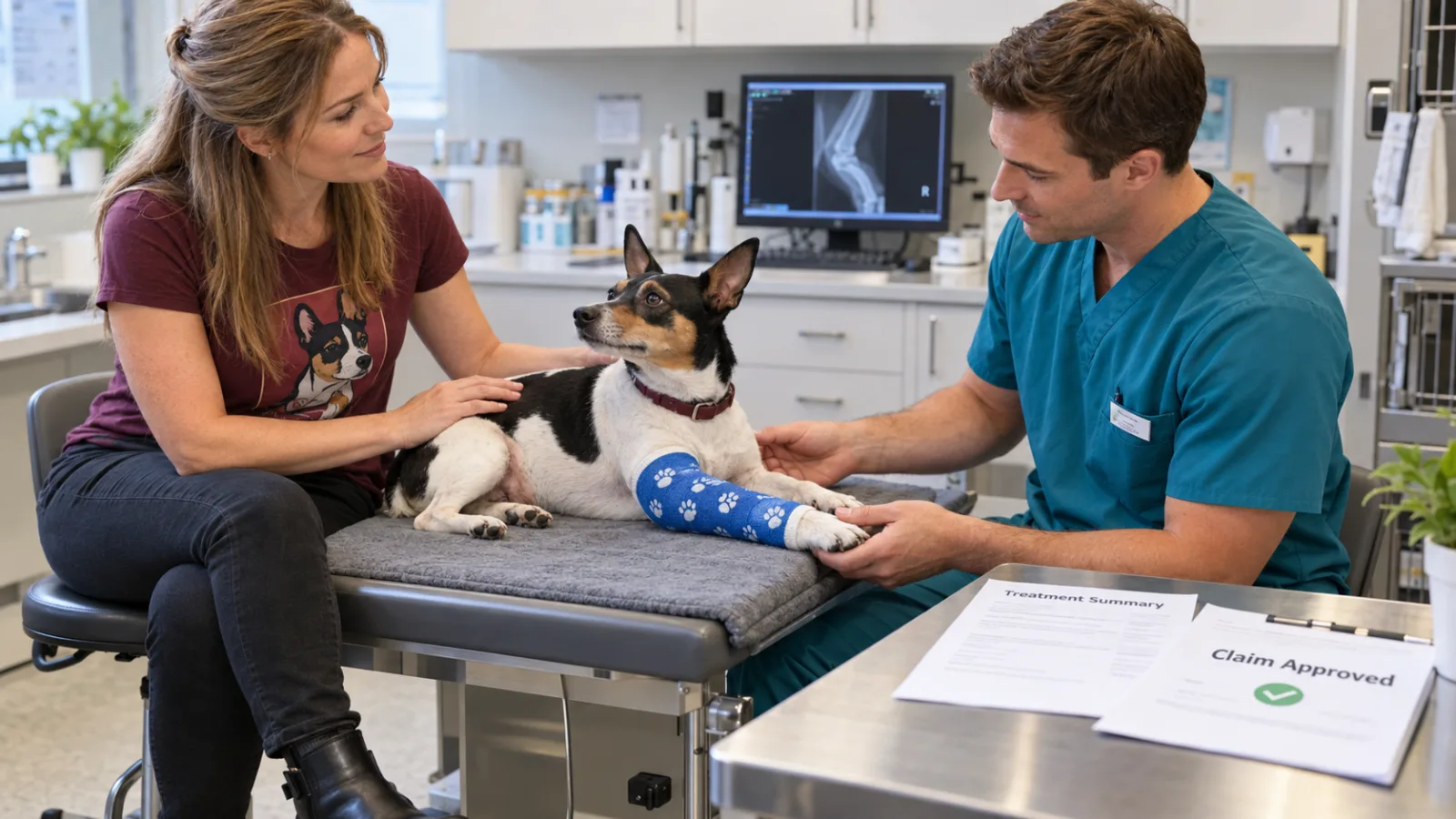
Updated September 23, 2026. This guide provides general information, not personalized veterinary or insurance advice. Coverage depends on your state, policy, and selected options.
How much does dog insurance cost? As a historical benchmark, NAPHIA's 2025 report put the average U.S. accident-and-illness premium for dogs at $62.44 per month, or $749.29 annually, based on 2024 data. This is not a current quote.
Insurance helps manage unexpected veterinary bills. It does not guarantee that you will receive more in claims than you pay in premiums.
Why Is Veterinary Care So Expensive?
Emergency Surgery, Hospitalization, and Imaging
Veterinary bills cover professional staff, equipment, anesthesia, medication, and monitoring. Emergency surgery may also require hospitalization and follow-up care. CT and MRI scans add diagnostic costs.
Ask for an estimate that includes the entire treatment plan. AKC notes that advances in veterinary medicine expand treatment options but can also increase costs.
Wellness Plans vs. Medical Insurance
A clinic wellness plan generally helps budget for routine services. It does not automatically cover emergency surgery.
Accident-and-illness insurance covers eligible unexpected injuries and diseases. Optional wellness benefits may help with vaccines and preventive care. Embrace explicitly describes its Wellness Rewards program as a membership, not insurance.
Compare its annual cost with the benefits you expect to use.
How Much Does Dog Insurance Cost per Month?
Age, Size, and Location
There is no reliable national price for every age and weight category. Insurers need details about your dog and ZIP code.
| Factor | How it can affect your quote |
|---|---|
| Age | Older dogs often cost more to insure |
| Breed and adult size | Expected health risks can affect pricing |
| ZIP code | Local veterinary costs influence premiums |
| Deductible | A higher deductible generally lowers the premium |
| Reimbursement and annual limit | More generous benefits generally cost more |
Pets Best identifies these factors in its pricing guidance. Compare quotes using the same deductible, reimbursement rate, and annual limit.
Be careful with cheap accident-only plans. Pets Best advertises dog accident-only coverage starting at $9 monthly, or $10 in Washington. These plans do not cover illnesses such as cancer or diabetes.
Breed-Related Conditions
For a French Bulldog, ask specifically about breathing disorders. For a large dog, ask about hip dysplasia and knee conditions.
Hereditary conditions are not automatically excluded. However, coverage may depend on symptoms, enrollment age, and waiting periods. Healthy Paws, for example, requires enrollment before age six for hip dysplasia coverage, with additional conditions.
What Does Dog Insurance Actually Cover?
Waiting Periods and Pre-Existing Conditions
A waiting period delays the start of certain coverage. Embrace currently lists a 14-day illness waiting period, with accidents covered from the policy's effective date. Orthopedic restrictions vary by state.
Pre-existing conditions generally include problems that began before coverage or during a waiting period. Symptoms can count even without a formal diagnosis. Some policies make exceptions for certain cured conditions.
Never delay veterinary care while waiting for insurance to begin.
Deductibles, Reimbursement, and Limits
Three terms matter:
- Deductible: The amount you must meet toward eligible expenses before benefits become payable.
- Reimbursement rate: The percentage of eligible expenses the insurer pays, subject to the deductible.
- Annual limit: The maximum the insurer pays during one policy year.
Most plans use an annual deductible. Trupanion uses a lifetime deductible for each condition. Once it is met, the same covered condition does not trigger another deductible while coverage continues. Separate conditions can trigger separate deductibles.
Ask how claims are calculated. Applying the reimbursement percentage before subtracting the deductible produces a different payment than subtracting the deductible first.
Exam Fees, Medication, and Behavior Treatment
Coverage for surgery does not mean every invoice item is covered. Trupanion excludes exam fees and routine care. Embrace says exam-fee coverage is optional on some policies.
Behavior treatment also needs checking. Embrace covers eligible behavioral therapy administered by a licensed veterinarian. That does not mean ordinary obedience classes are covered.
Dog Bite Liability
Standard pet medical insurance should not be treated as liability insurance. In the U.S., dog bite liability is commonly addressed through homeowners or renters insurance.
Ask that insurer whether your dog is covered. Breed restrictions, bite history, exclusions, and limits can matter.
Is Dog Insurance Worth It?
Insurance vs. an Emergency Fund
Consider this hypothetical example:
You pay $70 monthly, or $840 annually. Your dog needs $5,000 of eligible treatment. The policy has a $500 unmet annual deductible and 80% reimbursement, calculated after the deductible.
The insurer pays ($5,000 - $500) × 80% = $3,600. You pay $1,400 toward treatment, plus $840 in premiums. Your total is $2,240, assuming no other restrictions.
Saving $70 monthly builds only $840 in the first year. An early emergency could leave a large shortfall.
Insurance may be useful if a major bill would force you into debt or limit treatment. Self-funding may suit owners who already have accessible savings and can handle repeated expenses.
Keep emergency savings even with insurance. You may need to pay the clinic before receiving reimbursement. Trupanion offers direct payment at participating hospitals, but availability must be confirmed.
How Can Organized Medical Records Help?
Keep visit summaries, test results, prescriptions, itemized invoices, and payment receipts. Healthy Paws says a first claim requires medical history.
Your dog's Vupo profile can hold photos of their vaccination booklet, treatment dates, and medical notes. Keep policy documents and written coverage explanations alongside them. Organization can simplify a claim, but cannot guarantee approval.
Prevention still matters. AVSAB recommends reward-based training. Safe supervision and teaching your dog to leave objects alone remain important, whether insured or not.
Frequently Asked Questions
Does insurance cover vaccines and routine care?
Usually not under accident-and-illness coverage. Check optional wellness benefits and their limits.
Is there a maximum enrollment age?
Rules differ. Pets Best states that it has no upper enrollment age limit. Other providers restrict new enrollment or specific benefits. Check the minimum age for puppies too.
Is insurance worthwhile for an older dog?
Possibly. Compare the premium with coverage for new conditions and exclusions for existing problems. Do not cancel an existing policy before understanding what a replacement would exclude.
Are mixed-breed dogs cheaper to insure?
They can be, but not always. Age, size, location, and policy choices also affect the price.
Which company is best?
There is no universal winner. Compare exclusions, payment arrangements, deductible structure, and renewal costs. A low premium alone does not establish value.
U.S. Dog Insurance Comparison
These are established providers, not a complete market ranking. Prices require individual quotes. State-specific policy terms control.
| Provider | Main structure or feature | Important details to check |
|---|---|---|
| Trupanion | Lifetime per-condition deductible; no payout limits; direct payment at participating hospitals | Separate deductibles for unrelated conditions; exam fees excluded; reimbursement options vary by state |
| Pets Best | Annual deductible; customizable accident-and-illness plans; no upper enrollment age limit | Confirm exam-fee, prescription, rehabilitation, and dental benefits in the selected policy |
| Embrace | Annual deductible; eligible hereditary and veterinarian-administered behavioral treatment | Exam-fee and prescription options; state-specific orthopedic restrictions; wellness membership costs extra |
| Healthy Paws | Annual deductible; Signature Plan lists $5,000, $7,000, or unlimited annual reimbursement | Exam fees excluded; hip dysplasia enrollment and waiting rules; selected annual limit cannot later be increased |
Sources and Editorial Notes
Provider details were checked against official U.S. websites. Product availability, underwriting companies, state rules, and policy versions can differ. No personalized quotes were obtained. The NAPHIA price benchmark is explicitly historical; it is not presented as the latest 2026 average.
U.S. insurance and industry sources
- NAPHIA: 2025 State of the Industry release, reporting 2024 premiums.
- Pets Best: Coverage and exclusions.
- Pets Best: Pricing factors.
- Trupanion: Deductibles.
- Trupanion: Payout limits.
- Trupanion: Direct veterinary payment.
- Trupanion: Exclusions.
- Embrace: Coverage FAQ.
- Embrace: Waiting periods.
- Healthy Paws: Coverage, limits, eligibility, and claims FAQ.
- Insurance Information Institute: Insurance needs for pet owners.
Professional animal-care and behavior references
These support the original guide's general principles about planning for care, reading exclusions, maintaining records, and training. U.K. sources are not used to establish U.S. policy terms. Some organizations have commercial insurance partnerships.