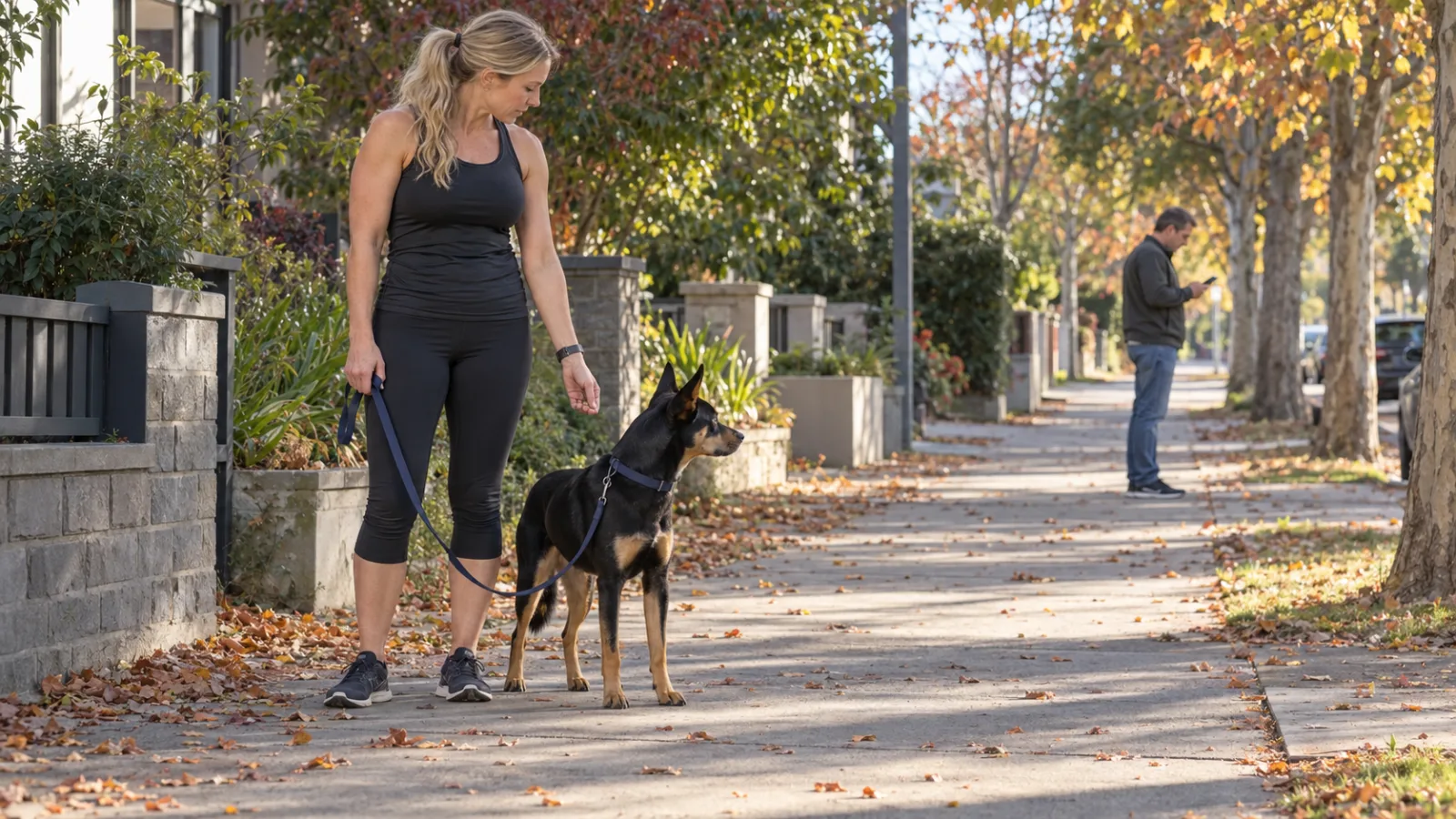
A dog who barks at visitors, retreats from unfamiliar people, or lunges when another dog approaches may be struggling with fear. The useful question is what would help that dog feel safe enough to learn.
Start by reducing overwhelming encounters. Then introduce carefully planned experiences in which the worrying thing predicts something the dog enjoys. This combines gradual exposure with counterconditioning. It takes adjustment to the individual dog, rather than a fixed schedule.
Understanding fear and aggression
Fear can produce avoidance, trembling, freezing, barking, or defensive aggression. These responses are not necessarily deliberate choices. A dog who stands still may be frightened rather than comfortable.
Fear is an important contributor to aggression, but the claim that it explains 99.9% of aggression has no established basis. Pain, resource-related conflict, frustration, learning history, and other factors can also matter. Predatory behavior requires a different assessment. Sudden behavioral changes warrant a veterinary examination.[1]
Addressing the emotional cause is essential when fear is involved. Still, learned behavior does not always disappear automatically as fear improves. A plan may also teach the dog to turn away, follow the handler, or settle at a comfortable distance.
Find a workable starting point
Identify the trigger and the details that make it difficult. With another dog, distance matters, but so do movement, staring, barking, narrow paths, and how many dogs are present.
Choose a setting where your dog notices the trigger while remaining reasonably comfortable. Look for a loose body, easy movement, normal breathing, and the ability to look away. Watch for tightening muscles, a closed mouth, a lowered posture, trembling, escape attempts, or a fixed stare. Interpret signals together and in context.
Eating is helpful information, not proof of comfort. Some distressed dogs still eat. Food refusal can also reflect appetite, food preference, or illness.
“Below threshold” is useful shorthand for a manageable level of exposure. It is not a precise boundary that stays the same every day. If you see tension building, increase distance before barking or lunging begins.
Two ways to practice
Use tiny, dog-safe treats your dog values. Plain cooked chicken may suit some dogs; allergies and prescribed diets require alternatives. Let the dog swallow comfortably. Never push food into the mouth or use hunger to force participation.
Open Bar, Closed Bar
This is a practical way to pair a manageable trigger with food:
- Arrange enough distance and keep an easy exit available.
- When your dog notices the trigger, begin offering small treats in a comfortable rhythm.
- When the trigger disappears, stop that particular stream of treats.
- Pause and assess your dog before another brief repetition.
The sequence matters: trigger first, food follows. In this exercise, food does not depend on a sit, eye contact, or another obedience response. The aim is a more positive association.[2]
You can use a warm voice if your dog enjoys it. Excited cheering is optional and may be too stimulating for some dogs. Keep your delivery calm and predictable.
Do not keep the dog near something frightening merely to finish the exercise. If distress develops, retreat. You may use food to support a safe exit; protecting the dog takes priority over a perfectly timed “closed bar.”
Mark a brief look
The original article calls this “Click the Trigger.” A marker can help teach a specific behavior, such as noticing a trigger briefly and turning back toward the handler. That adds an operant training component; a clicker is not required for classical counterconditioning.[3]
- First teach the marker, away from triggers: the click or brief word predicts a treat.
- Begin at a distance where your dog can notice the trigger without becoming tense or fixated.
- Mark a brief look and promptly offer the treat in an easy-to-reach position toward you or away from the trigger.
- Allow a comfortable turn. Do not pull the head around, crowd the face, or lure the dog closer to the trigger.
- Pause between repetitions. If the dog cannot disengage, increase distance rather than repeatedly clicking.
A marker that startles the dog is unsuitable. Whether this exercise is useful depends on the dog and the training goal. These two formats should not be presented as universally effective or as proven superior to other well-designed behavior plans.
Build progress without rushing
Look for relaxed observation, easier disengagement, and faster recovery. Happy excitement is not a requirement. Calm neutrality may be an excellent outcome, especially around strangers or unfamiliar dogs.
After repeated comfortable experiences, change one feature slightly: distance, duration, or movement. A shorter distance is not automatically the next goal. Your dog may first need practice in the same setting on another day.
Record the setting, trigger, approximate distance, body language, and recovery. Use the notes to spot patterns rather than to enforce a deadline.
If your dog reacts, create space and end or simplify the session. A difficult encounter may cause a setback, but it does not automatically erase all previous learning. Avoid blaming yourself or the dog. Unexpected events happen; review what can be changed next time.[4]
Manage walks and visitors
Choose quieter walking times and routes with room to turn away. Cross the street early or use a visual barrier. Avoid crowded dog parks as an exposure exercise for a dog afraid of other dogs.
Before visitors arrive, prepare a familiar room or comfortable area where your dog can settle away from them. Use secure barriers appropriate to the risk. This only helps if the dog feels safe there; a dog distressed by isolation needs another arrangement.
Tell visitors not to approach, stare, reach over, or insist on touching. Treats should not be used to lure a fearful dog into contact. A dog can live well with a visitor plan that includes comfortable separation rather than greetings.
When bite risk exists, work with a professional on management and gradual, reward-based basket-muzzle conditioning. A muzzle is an additional safeguard, not permission to force exposure.
The supplied Debbie Jacobs passage emphasizes preventing frightening encounters. The practical distinction is between overwhelming exposure and carefully controlled exposure that the dog can handle. Avoidance protects the dog now; appropriately paced training can expand future options.
When professional help matters
Seek veterinary assessment for sudden fear, pain-related reactions, severe anxiety, or aggression. A veterinarian may recommend medical treatment alongside behavior work. Medication, when appropriate, is a clinical decision rather than evidence that training has failed.
Choose a reward-based professional with relevant fear and aggression experience. Ask how they assess risk, recognize distress, and adjust a plan. Avoid punishment of fear reactions: it can worsen distress and suppress warning signals without resolving the cause.[5]
The Pet Professional Guild is one possible starting point. Directory membership alone does not establish suitability for your case. In the United States, ask your veterinarian about a board-certified veterinary behaviorist when needed.
For related practical reading, explore more dog behavior guides in Vupo’s Knowledge Center.
Frequently Asked Questions
Does aggression always mean fear?
No. Fear is common, but the cause needs assessment. Pain and other motivations can contribute, and more than one factor may be involved.
Can treats reinforce fear?
Fear is an emotional response, not an obedience behavior. Pairing a manageable trigger with food can help change its meaning. Specific behaviors can also be reinforced, so a professional may adjust timing and setup when needed.
What if my dog refuses food?
Increase distance and assess the whole situation. Do not bring the dog closer or press food into the mouth. Persistent appetite changes outside training need veterinary attention.
Does one reaction erase progress?
No. It can indicate that the situation was too difficult and may cause a setback. Allow recovery and make the next session easier.
Must my dog greet strangers?
No. Comfortable distance and safe management can be appropriate long-term goals. Willingness to approach does not automatically mean willingness to be touched.
How long does treatment take?
There is no reliable universal timeline. Severity, health, environment, and the ability to control exposure all affect progress. Review the plan if welfare or safety is not improving.
Professional References
- Merck Veterinary Manual: Behavior Problems in Dogs. Veterinary overview of aggression and medical contributors.
- VCA: Introduction to Desensitization and Counterconditioning. Clinical guidance on graded exposure and adjusting difficult sessions.
- AVSAB: Should You Use a Secondary Reinforcer (Clicker) in Counter Conditioning?. Expert explanation distinguishing emotional associations from marker-based behavior training; not a comparative canine clinical trial.
- AVSAB: Staying Safe - Management for Fearful Dogs. Expert guidance on management and responding constructively to setbacks.
- AAHA: Changing Behaviors. Professional guidance on behavior modification, flooding, and aversive methods.
Sources checked October 30, 2026. These references support the principles; they do not establish a guaranteed success rate for either named exercise.