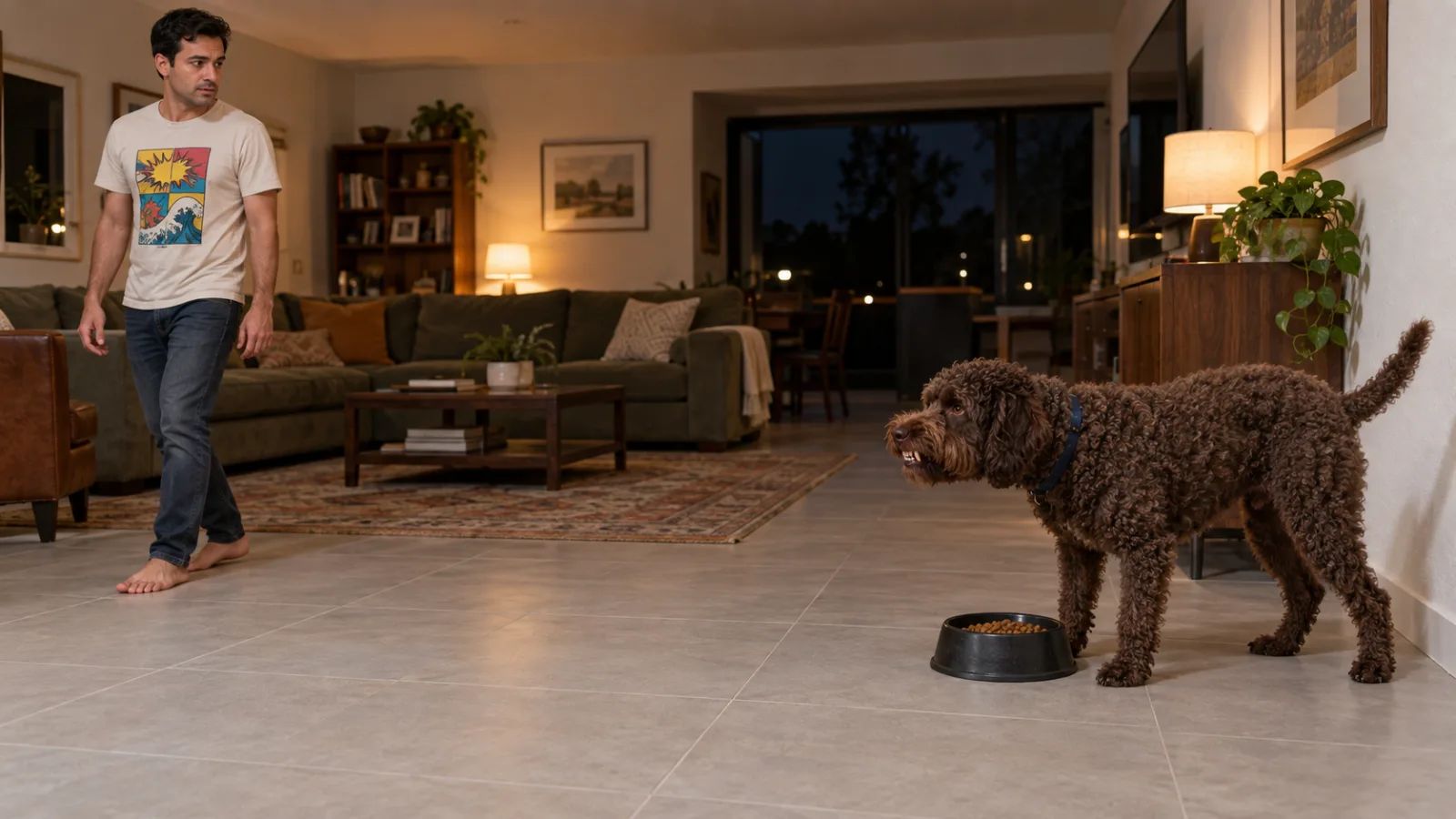
You walk past the food bowl, and your dog stiffens. You reach for a toy, and your dog growls. This can be frightening, especially when your dog usually enjoys your company. Resource guarding in dogs does not automatically mean your dog is trying to control the household. Your dog may be worried about losing something valuable and trying to keep you away. [1]
If your dog is growling right now, stop approaching, keep your hands away, and calmly move back. Do not try to take the item. A growl is a warning to respect, not a challenge to prove who is stronger. [1]
What Is Resource Guarding?
Resource guarding is behavior a dog uses to keep access to something valuable. That resource may be food, a chew, a toy, or a stolen sock. Even an empty food bowl can trigger guarding. [2]
Guarding does not always look like food aggression. A dog may carry an item away or stand over it to block access. The term "possessive behavior" does not capture every form of guarding. Look at what happens, who is nearby, and the situation. [2]
A dog that guards toys may be comfortable with you near the food bowl. A dog that guards from another dog may not guard from people. Each situation needs its own assessment. [1]
Early Warning Signs People Often Miss
Small changes may appear before growling:
- Your dog carries the item away when someone approaches.
- Your dog starts eating faster.
- The head lowers over the bowl, and the body blocks access.
- Chewing stops, the mouth closes, and the body freezes.
- Your dog gives a hard stare or watches the approaching person from the side.
- More obvious warnings may follow: a lifted lip, exposed teeth, growling, snapping, or an attempted bite. [2]
These signs do not follow a fixed sequence. Dogs may skip signs, and people may miss them. One signal alone is not a diagnosis. Read the whole body and consider the context. [2]
If your dog growls when you approach the food bowl, you are already too close for comfort. Do not approach again to test whether the problem is real. [3]
What Is Your Dog Trying to Achieve?
The immediate goal is to keep the approaching person or animal away and retain the resource. When growling makes someone back off, a dog may learn that it works. Still, you should move away during an incident. Preventing a bite takes priority. Teach a different response later, under planned conditions. [2,3]
Repeatedly taking items or chasing a dog can increase concern about losing them. However, guarding does not prove that a dog was starved or abused. Dogs that have always had enough food can guard it, too. [2]
A growl does not establish "dominance." A professional assessment considers the dog's emotions, learning history, and circumstances. Training should use rewards rather than intimidation. [1,4]
What Not to Do
Do not repeatedly remove the bowl to "get your dog used to it." Do not put your hands in the food or pet your dog during meals to test tolerance. Taking food by force may reinforce the expectation that your approach means losing something. [3]
Do not yell, hit, pin your dog down, or punish growling. Punishment can increase fear and aggression. It may also suppress a warning without resolving the underlying concern. A quiet dog is not necessarily a relaxed dog. [1,4]
If your dog growls when you try to take a toy, do not chase or corner your dog. Do not turn the situation into a tug-of-war to force the item away. [1]
A Clear Safety Plan for Home
Make sure everyone in the household follows the same rules:
- Offer meals and chews in a quiet area behind a closed door or a secure pet gate.
- Separate pets during meals and prevent access to one another's bowls.
- Pick up bowls and items only after the dog has moved away and is safely separated.
- Keep trash, laundry, and dangerous objects out of reach.
- If guarding occurs, stop, move away, and keep others from approaching. [1,5]
If the item is safe, leave it until you can retrieve it without a confrontation. If it is sharp, toxic, or could be swallowed and cause harm, call your veterinarian or an emergency veterinary hospital immediately for guidance. Do not reach into the mouth of a dog that is threatening to bite. [1]
Management reduces dangerous encounters. It does not prove that the dog's feelings about the resource have changed. [1]
How Behavior Change Begins
If your dog is already growling, start with a professional risk assessment. If there has been biting, lunging, snapping, or an attempted bite, do not practice approaching resources on your own. [3]
The goal is to change your dog's expectation: a person nearby predicts something good. Professionals often combine desensitization, or gradual exposure at a comfortable intensity, with counterconditioning, which builds a positive association. [3]
Once a professional has tailored the exercise to your dog, an initial step may look like this:
- An adult stays far enough away that the dog eats comfortably without guarding signs.
- From that distance, the adult gently tosses a favorite treat toward the dog, without reaching for the bowl, and moves away.
- The practice stays brief. Eating the treat is not a reason to move closer immediately.
- Distance decreases gradually, based on consistently relaxed responses and professional guidance. [3,6]
Freezing, faster eating, a hard stare, or growling means it is time to stop and reassess. Accepting a treat alone does not prove that a dog feels comfortable. [2,3]
Separately, you can teach a trade using an item your dog does not guard. Offer a better reward, wait for a voluntary release, and reward it. Sometimes return the original item if it is safe. Do not start with the most prized chew. Stay and impulse-control exercises can support daily routines, but they do not replace changing the dog's feelings about the resource. [5]
Resource Guarding Around Children
Children should not take part in approach or trade exercises with a dog that guards. Do not ask a child to give treats so the dog will "get used to them." [3]
Use physical separation during meals and chewing. Explaining the rules or watching from across the room does not replace a barrier. Children should not touch the bowl, take toys from the dog's mouth, or approach a dog holding an item. If your dog guards from a child, seek professional help promptly. [6]
When Professional Help Is Essential
Choose a trainer or behavior consultant with documented experience treating resource guarding and aggression. Ask how they assess bite risk and confirm that they use reward-based methods. A general training credential alone does not establish expertise in aggression. [3,4]
Get help promptly after a bite or attempted bite, if your dog chases people away, if children are involved, or if you cannot manage safety at home. [3,6]
Sudden guarding or worsening behavior also calls for a veterinary exam. A medical problem may be contributing. Complex cases may need a board-certified veterinary behaviorist, a veterinarian with advanced training in behavior. In the US, look for the DACVB credential. [3,6]
Need help getting started? Schedule a consultation with a qualified local professional. You can use the CCPDT trainer and behavior consultant directory as a starting point. Ask specifically about resource guarding experience. Explain what your dog guards, who triggers the response, and whether any bites or attempted bites have occurred. [3,7]
Frequently Asked Questions
Why Does My Dog Growl When I Approach the Food Bowl?
Your dog may be trying to keep you away from something valuable. Growling alone does not explain every contributing factor. [1]
Should I Take Away the Food Bowl to Teach My Dog?
No. Repeated removal can increase concern. Teach your dog that your presence predicts something good. [3]
Can Resource Guarding Lead to a Bite?
Yes. Do not keep approaching to find out how serious your dog is. [6]
Can Puppies Guard Resources?
Yes. A puppy guarding food is not necessarily going through a phase that will disappear. Address the signs early and get guidance. [1]
When Should I Contact a Trainer?
Seek help when guarding signs become a repeated pattern. Contact a professional promptly after an attempted bite or when children are involved. [3,6]
Professional Sources
- Dogs Trust - Resource Guarding in Dogs. Guidance from its behavior team.
- Preventive Vet - Resource Guarding in Dogs. By certified trainer and behavior consultant Cathy Madson.
- ASPCA - Food Guarding. Risk assessment, management, and behavior modification.
- American Veterinary Society of Animal Behavior - Position Statements. Humane dog training guidance.
- RSPCA Brighton - Resource Guarding. Guidance on changing behavior around valued resources.
- American Kennel Club - What to Do When Your Dog Steals and Guards Items. Warning signs and professional support.
- Certification Council for Professional Dog Trainers - Directory. A US resource for finding certified trainers and behavior consultants.