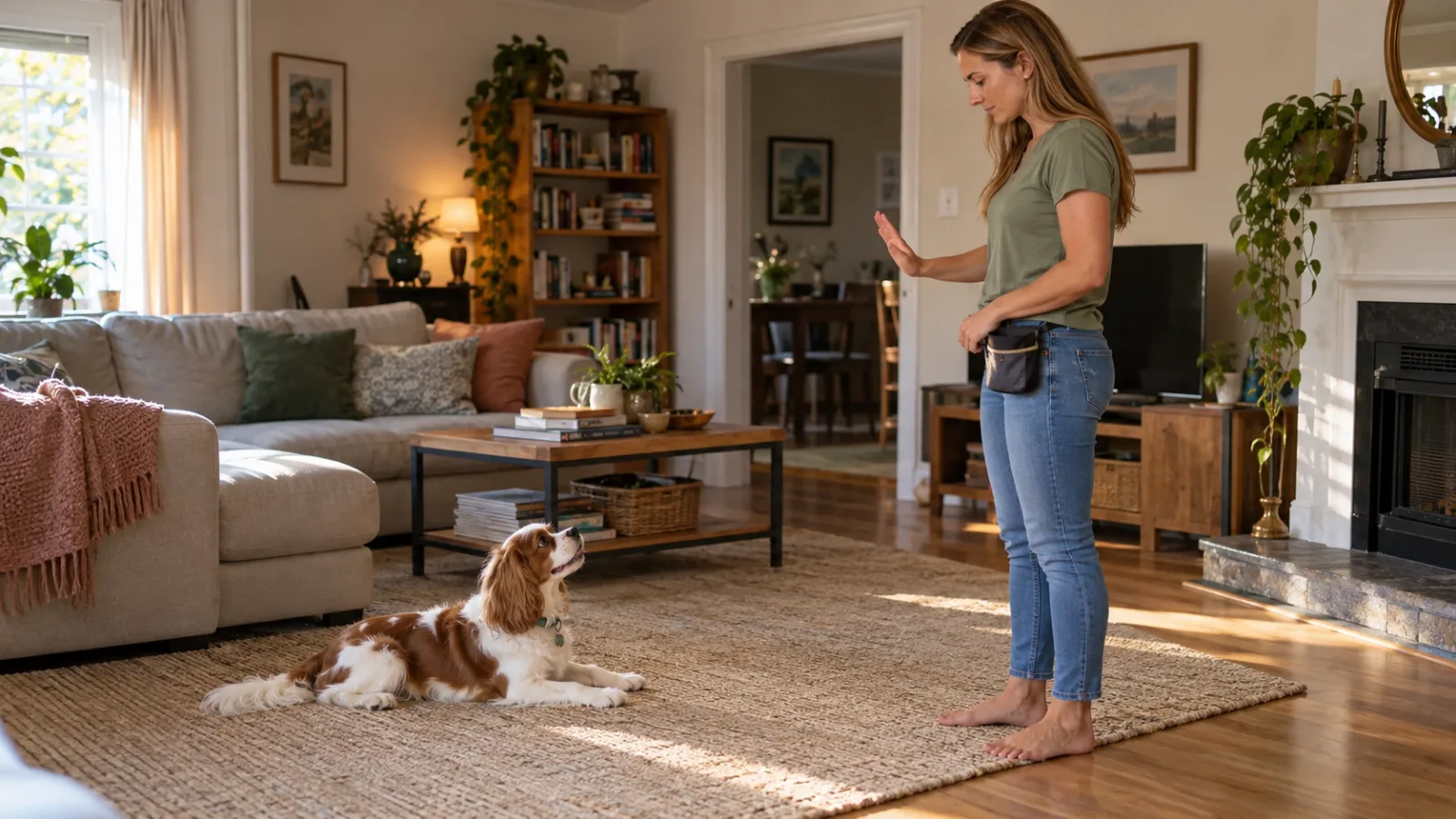
Does your dog bolt the moment the front door opens? Do they immediately rush over when you set down a plate? If you are wondering how to teach a dog to stay, start with a small task: staying in a comfortable position for one second, with you right next to them. Later, you add time, distance, and distractions.
Training the stay command teaches a clear rule: remain in place until receiving a signal that it's over. The practice is based on rewards and gradual progress. There is no need for yelling, leash corrections, or physically holding the dog down. This is also the approach recommended by the American Veterinary Society of Animal Behavior.
Why is "Stay" a Crucial Safety Command?
Preventing Running into the Street, Bolting Out Doors, and Rushing Guests
"Stay" can help when opening a door, attaching a leash, or welcoming guests. It gives the dog a clear action to perform instead of running forward. However, no exercise guarantees a perfect response in every situation. Near a road, always use a leash, and at home, prevent free access to the exit.
A dog sitting without moving isn't necessarily calm, either. If they are fearful or tense, it is not enough that they stay in place. Decrease the difficulty and move them away from the stressor. Impulse control for dogs should not turn into a struggle.
The 3Ds of Dog Training: Three Variables to Keep Separate
The three variables are Duration, Distance, and Distraction. This is a practical framework for planning training sessions, based on a gradual increase in demands. Increase only one variable at a time, and make the other two easier. Success in the living room does not guarantee success next to a running dog.
Duration: From One Second to a Minute
Start with a second or two next to the dog. Slightly increase the time, and mix in easier repetitions: for example, two, four, and back to two seconds. You don't have to break a record on every attempt. Later, you can approach a minute if the dog is relaxed and successful. A minute is a possible goal, not a baseline requirement.
Distance: Moving Away Step by Step
Initially, it is enough to shift your weight backward and return. Then try half a step, one step, and two steps. When increasing distance, shorten the wait time. Turning your back and disappearing from sight are additional challenges, so save them for later.
Distraction: Movement, Toys, and Noises
Start with a small hand movement or a person walking by in the distance. A toy placed on the side is easier than a thrown toy. Add tossing only later, gently and at a distance. Do not surprise the dog with a loud noise to "test them." If they struggle, weaken the distraction.
A Practical 4-Step Training Protocol
Before starting, choose a quiet room, a non-slip surface, and small treats the dog loves. Start when they are ready to learn. Short, pleasant sessions with breaks are better than prolonged and frustrating practice. Blue Cross also recommends reward-based training.
Step 1: Choosing a Release Word
Choose a consistent word, like "Free." Ask for a "Sit" or "Down," give a treat while the dog is in position, and then say "Free." After the word, gently encourage them to move. This is how they learn what ends the exercise.
Ensure everyone in the household uses the same word. "Okay" can work if it isn't used for another cue. The goal is to teach a dog not to get up until released, without leaving them guessing when the exercise is over.
Step 2: Rewarding for Staying in Place
Ask for the position, say "Stay" once, and present an open palm. Wait one second, and give a treat when the dog is still in place. Then release.
Bring the treat to their mouth so they don't have to get up or move forward to receive it. In a "Down," you can offer it low, between the front paws. Repeat a few times and end with success. The RSPCA emphasizes rewarding during the stay and keeping sessions short and regular.
Later, occasionally give several treats during the same stay. The treat is not the release word. If the dog is used to a clicker ending an exercise, do not click in the middle of the wait without first teaching an appropriate meaning.
Step 3: Adding Distance and Returning to the Dog
Ask for "Stay," move half a step away, and return immediately. Reward in place and only then release. Later, gradually increase the distance. According to Dogs Trust, returning to the dog and rewarding in position reinforces staying in place.
Do not simultaneously increase both distance and time. A stay command with distance and time is built from combining skills already practiced separately.
Step 4: Practicing in a Challenging Environment
Move to a secure yard or a quiet corner in a park, with an appropriate leash. Start close and for a short time again. Near stairs, practice on a wide, flat surface, away from the edge. Don't expect the same level in every new place.
Facing the temptation of food, place a bowl far away and ask for a short stay. Reward from your hand. If the dog moves forward, move the bowl further away and make it easier. Later, you can release them to go to it. Do not use dangerous food or place accessible food that the dog is likely to snatch. "Leave it" is a separate exercise worth teaching alongside the stay.
Common Mistakes That Cause the Dog to Get Up Prematurely
- Raising multiple demands together: Moving away, waiting, and throwing a ball in the same attempt.
- Rewarding late: The treat arrives only after the dog gets up.
- Dragging out the exercise: Waiting for them to fail instead of releasing in time.
- Repeating "Stay" over and over: The dog does not get a chance to learn to respond to a single cue.
- Punishing for getting up: Yelling or pulling does not explain what is required. Make it easier and reward a successful attempt.
Teaching a dog to stay also requires adjusting to their comfort. Do not demand prolonged sitting on a hot, wet, or uncomfortable surface.
Frequently Asked Questions
At what age can you start teaching a puppy to "Stay"?
You can start at a young age, usually around eight weeks, with simple practice at home. Start with one second and only after the puppy understands the requested position. Do not expect long waits from them.
Why is it forbidden to call a dog to "Come" out of a "Stay"?
It is not an absolute prohibition. At the beginning of learning, it is better to return and release next to the dog, so they don't anticipate running to you. Later, you can teach that "Come" ends the stay. Maintain a consistent rule.
What to do if the dog gets up before the release word?
Do not scold or push them back. Start a new, easier attempt: less time, less distance, or fewer distractions. If they repeatedly get up, stop for a break and check what is making it difficult for them.
Which is better: sitting or lying down?
Both are suitable. Sitting is comfortable for a short wait, and lying down may be suitable for a longer wait. Choose a position comfortable for the dog; there is no need to force them into a posture that makes it difficult.
How to teach a dog not to bolt out the front door?
Attach a leash before opening and stand at a distance from the door. Practice separately touching the handle, moving the handle, and opening it slightly. Reward staying at each stage. If the dog moves forward, stop the opening and make it easier, without slamming it on them. Only go out together after the release.
Turning Small Successes into a Habit
Impulse control exercises for dogs blend into the routine: before going out, next to a bowl, or when guests enter. Basic obedience for a dog is built from clear and consistent practice.
Practice it alongside your Vupo training plan. Set a small goal and keep your own notes on what worked: how many seconds, at what distance, and in what environment. Progress according to the dog's performance, and not by the pressure to reach a weekly goal.
To continue practicing, read our guides on "The Come Command and Building a Reliable Recall" and "How to Prevent a Dog from Jumping on People".