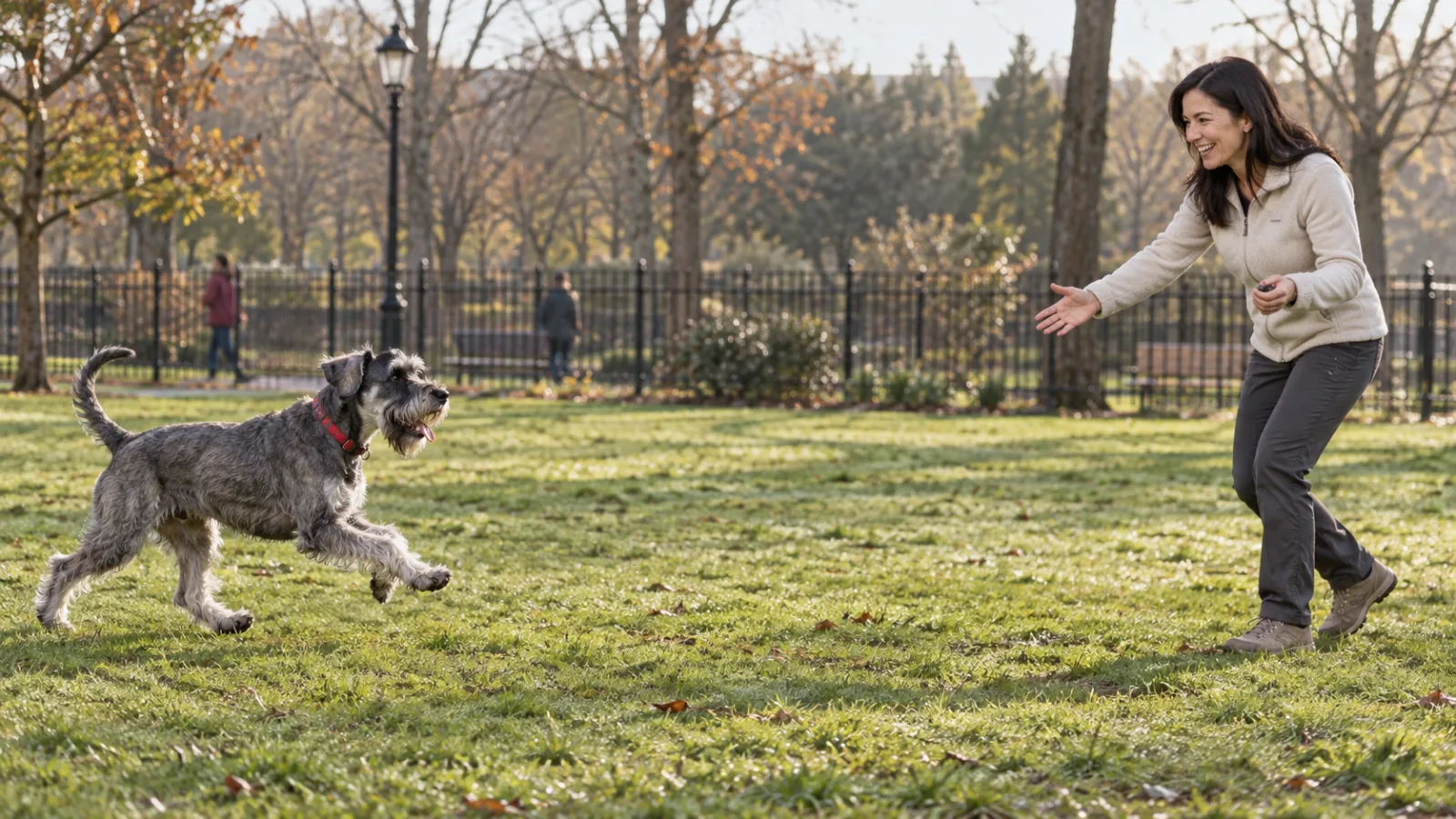
You call your dog, but they keep sniffing as if you are not there? At home, they come running. Outside, everything changes? Teaching your dog to come when called starts with a simple principle: coming back to you needs to be rewarding, and the difficulty should increase gradually.
The "Come" command is the most important command to teach a dog outdoors. A reliable recall can help prevent your dog from running off or getting lost, and it may even save their life. Still, no recall guarantees a response in every situation. Near roads and in unsafe areas, even a well-trained dog needs a leash.
Why Does Your Dog's Recall Become Less Reliable?
Your Dog Learns to Tune Out Their Name
Repeatedly calling your dog's name while they are busy and unresponsive can turn it into background noise. Make a distinction between their name, which asks for attention, and "come," which asks them to approach you. Say your recall cue once, in a situation where your dog has a good chance of responding.
A Negative Association: Coming Back Ends the Fun
If coming to you always leads to being leashed or scolded, your dog has a reason to hesitate. Clipping on a leash does not ruin recall by itself. The problem is a pattern in which returning to you mainly predicts losing access to enjoyable activities.
Chasing Turns Running Away Into a Game
Chasing a dog who is moving away can become a fun game for them. It can also frighten them and make them move farther away. During planned training, use a fenced area or a long line to prevent escape instead of trying to outrun your dog.
A Four-Step Recall Training Plan
Step 1: Start in the Living Room With a High-Value Reward
Choose a calm moment, prepare small pieces of a favorite treat, and stand a step or two away. At first, say "come" as your dog is already starting to approach. When they reach you, say "yes!" and reward them immediately.
After several successful repetitions, say the cue before your dog starts moving toward you. You can offer a "jackpot": several small treats given one after another. Keep the food in your pocket until your dog arrives so that showing a treat does not become a requirement for responding.
Practice three to five short repetitions and stop while your dog is still interested. Later, practice calling them from one room to another. Starting indoors and gradually increasing distance are also recommended in the RSPCA's recall training guide.
Step 2: Move Outdoors with a Long Training Line
Choose a quiet, open area away from roads. A 30–50 foot leash allows for distance training, though you should start with just 6–10 feet. Attach it to the collar, hold it without wrapping it around your hand, and prevent it from getting tangled with people or dogs.
Call when your dog is not too distracted, reward their return, and let them go back to sniffing. The line is a safety measure, not a tool for pulling your dog toward you or delivering leash corrections. Do not let your dog build up speed and hit the end of the line.
Increase the distance only after repeated success. One possible training benchmark is at least eight successful responses out of ten across several sessions. That is a measure of progress, not permission to go off leash.
Step 3: Practice "Come, Then Go Play"
This exercise helps build your dog's willingness to return:
- Let your dog sniff in a safe area.
- Say "come" during a natural pause.
- Reward them when they come all the way to you.
- Gently touch their harness if they are comfortable with that contact.
- Say "free" and let them return to their activity, keeping the same safety precautions in place.
Your dog learns that coming back can add to the fun without ending it. Later, in a secure fenced area, you can practice briefly clipping on a leash, rewarding your dog, and releasing them again. Even when it really is time to go home, reward their return. The RSPCA also recommends avoiding a pattern of calling your dog back only to put them on a leash.
Step 4: Introduce Distractions Gradually
Change one variable at a time: the distance between you and your dog, the intensity of the distraction, or the training location. When adding a distraction, shorten the distance again.
You might start near a ball resting on the ground, then progress to a person holding a ball. Around other dogs, begin far enough away that your dog can disengage and respond, rather than calling in the middle of intense play.
If your dog repeatedly struggles, move farther from the distraction and make the exercise easier. If they cannot even show interest in a favorite reward, the environment may be too challenging for training at that moment.
Body Language That Encourages Your Dog to Come
Move Backward and Use an Inviting Voice
Be engaging: turn slightly sideways, take a few steps backward, and use a cheerful voice with a slightly higher pitch than usual. You can bend your knees and lower yourself if it is comfortable and safe. Avoid looming over your dog or suddenly reaching toward them.
Match your enthusiasm to your dog. A sensitive dog may prefer a quieter invitation. The goal is to encourage them to approach without frightening or overwhelming them.
Emergency: Your Dog Is Running Toward a Road
Encourage Movement Toward Safety Without Putting Yourself at Risk
No training technique guarantees that a dog will stop in an emergency. Do not run into traffic or call your dog across a road to reach you. If you are on the same side and there is a safe route, try calling in a familiar voice while moving away from the road. Offer a familiar treat or toy if one is available.
Running in the opposite direction is only appropriate if it leads away from danger and does not encourage your dog to cross the road.
When your dog reaches you, calmly secure them and reward them. If you lose sight of them, begin an organized search and report them missing.
Rules for Building a Reliable Recall
- Be engaging: An inviting voice and a few steps backward can encourage your dog to approach.
- Reward every return: Use a treat, a game, or an activity your dog truly enjoys.
- Never scold a late arrival: Your dog may associate your anger with coming back, rather than with the delay.
- Release them again when it is safe: During many practice repetitions, let them return to sniffing or playing.
- Avoid repeating the cue: An unsuccessful recall is a reason to make the exercise easier.
- Keep practice short and consistent: A few minutes each day are better than an exhausting session.
- Maintain safety precautions: Successful training does not eliminate the need for a leash and a safe environment.
Frequently Asked Questions
Why Does My Dog Come at Home but Ignore Me at the Dog Park?
There are usually fewer distractions at home, and dogs do not automatically transfer a learned skill to every location. Start practicing outside the dog park, at a manageable distance from other dogs.
Can I Scold My Dog if They Take Five Minutes to Come Back?
No. Reward their return and choose easier conditions for the next session. Coming back to you should remain safe and rewarding.
What Treats Should I Use?
Choose small treats your dog especially enjoys that are suitable for their diet, such as plain, cooked, boneless chicken. You do not need hot dogs or cheese. A reward's value depends on your dog's preferences.
What Is a "Poisoned Cue"?
A cue becomes poisoned when it is associated with an unpleasant experience, leading to hesitation or avoidance. Repeating a cue without a response mainly weakens its meaning. If your recall cue has developed a negative association, you can teach a new word using rewards.
How Can I Teach a Puppy Before Starting Formal Training?
In a safe indoor space, take advantage of moments when your puppy is already following you. Move a short distance away, invite them over cheerfully, and reward them for approaching.
How Do I Teach My Dog to Come Back at the Dog Park?
Start in a quiet, securely fenced park, call during breaks in play, and make returning to play part of the reward. Avoid using a long line among running dogs because it can become tangled.
What Should I Do When My Dog Ignores the Recall Cue?
Calmly move closer if it is safe, reduce distractions, and practice over a shorter distance. If the difficulty persists, consult an experienced trainer to adjust the training plan.
From Daily Practice to Preventing Lost Dogs
Basic dog training skills develop through successful repetitions. Include short recall exercises in your Vupo training plan alongside your daily walks. If your dog goes missing, Vupo's lost-and-found tools and community can help support the search. They complement prevention.
For related reading on the blog, see "Emergency Guide: Lost or Found Dog" and "Dog Parks in Israel."