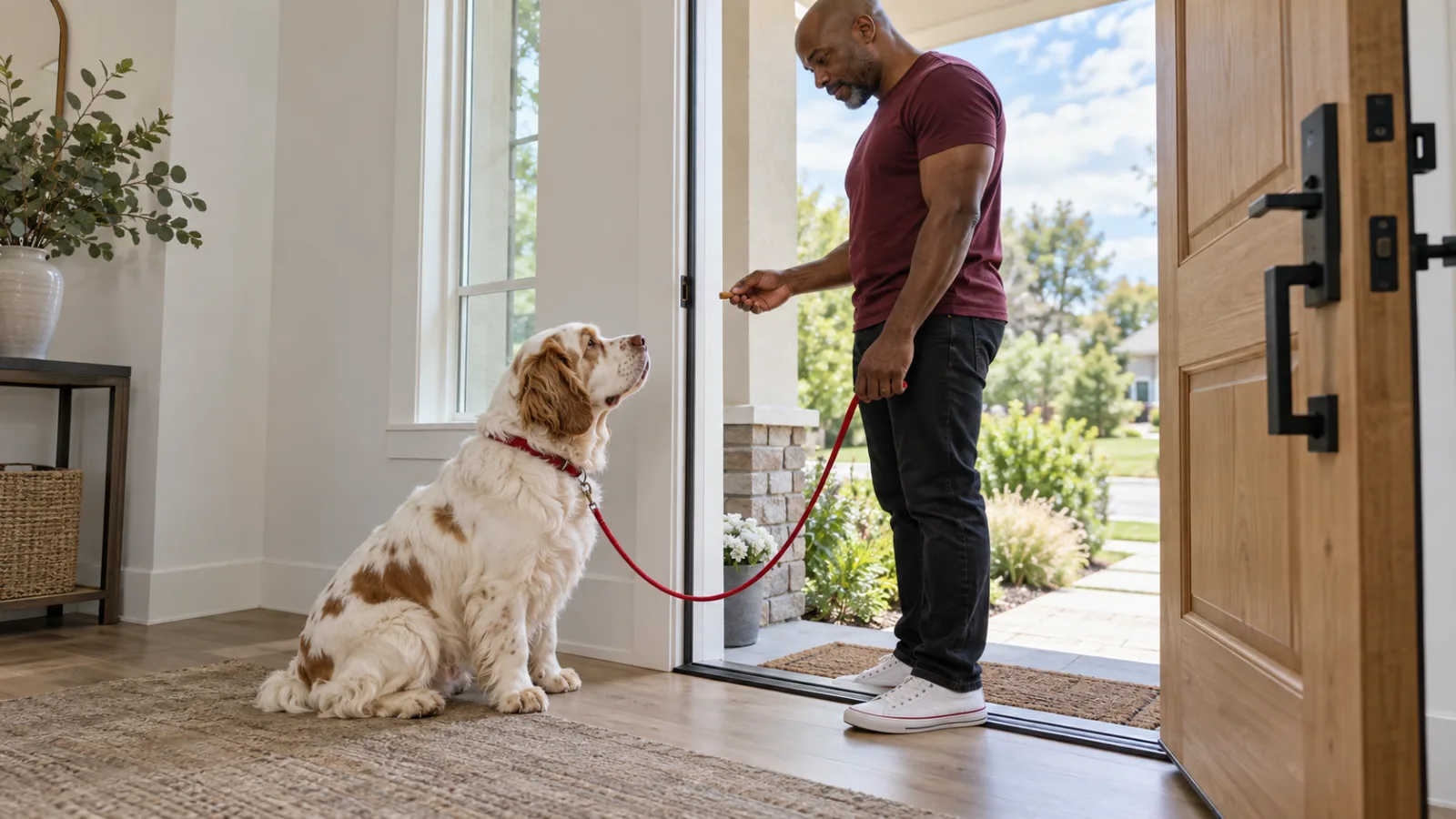
Some dogs hear a key turn, see a hand reach for the doorknob, and immediately rush toward the opening. If your dog bolts out the front door, this is more than a manners problem. It is a safety problem.
An open door can lead to a busy street, a driveway, an apartment hallway, a stairwell, or an unexpected encounter with another dog.
The good news is that you can teach a clear doorway threshold rule with positive, step-by-step training. The goal is not to make your dog afraid of the door. The goal is to teach one simple rule:
An open door does not mean permission to go outside.
That is the foundation of how to stop a dog from bolting out the door.
Why Do Dogs Rush Out the Door?
Barrier frustration and curiosity about what is outside
Outside the home, there are smells, people, dogs, movement, wildlife, delivery drivers, and many other interesting things.
For a curious or highly excited dog, the front door is the only barrier between them and all of that stimulation.
If your dog has successfully rushed outside before and then enjoyed running, sniffing, exploring, or greeting someone, the behavior may have reinforced itself. From the dog's point of view, rushing through the door worked.
That is why training a dog not to run out the door should include two things at the same time:
- Prevent more successful door-dashing whenever possible.
- Teach a safer behavior that earns access to what the dog wants.
Classical conditioning: the door predicts excitement
Many dogs become excited before the door even opens.
The doorbell may predict visitors. Shoes and a leash may predict a walk. A hand moving toward the doorknob may predict that the outside world is about to become available.
Over time, the dog may build a strong emotional response to these signals.
For some dogs, you need to train more than the actual doorway crossing. You may also need to practice calm behavior around the doorbell, knocking, the doorknob, and the sound of the lock.
Start with low-intensity versions of these triggers and reward calm behavior.
Why Door-Dashing Is Dangerous
Traffic, driveways, apartment hallways, and unexpected dog encounters
A dog that rushes through an open door may reach the street before the owner can react.
In a house, the dog may run into the driveway or toward passing cars. In an apartment building, the dog may rush into a hallway, stairwell, lobby, or elevator area.
The dog may also run directly into another dog at close range. That can become dangerous very quickly, especially if the other dog is fearful, reactive, or on leash.
Do not rely on training alone while the behavior is still developing.
Use layers of safety, such as:
- A leash
- A baby gate
- An exercise pen
- A second interior barrier
- A closed storm door or screen door when appropriate
Until the behavior is reliable, do not "test" your dog with an open front door that leads directly to the street.
The "Invisible Boundary" Protocol: Positive Doorway Threshold Training
Step 1: Teach calm waiting at a closed door
Start when the house is quiet.
Do not begin when guests are arriving or when you are in a hurry to leave.
Bring your dog to the door on leash. Wait for calm behavior.
That may look like:
- Four paws on the floor
- A loose leash
- Standing quietly
- Sitting
- Lying down
Reward immediately.
Your dog does not have to sit.
A sit can be useful, but the real goal is simple: the dog stays behind the threshold until released.
Repeat several short sessions until your dog starts to understand that calm behavior near the door pays off.
Step 2: Add movement of the doorknob
Now touch the doorknob.
If your dog stays calm, mark the behavior with a word such as "yes" and give a treat.
Next, turn the knob.
Then open the door just one inch.
If your dog moves forward quickly, do not yell and do not push the dog back.
Simply close the door calmly before the dog crosses the threshold.
This is the key part of the protocol.
The dog learns a clear pattern:
Moving forward makes the opportunity to go outside disappear. Staying calm makes the door open farther.
There is no need for anger.
If your dog keeps failing, the exercise is too difficult. Make it easier. Open the door less, increase your distance from the door, or use better food rewards.
Step 3: Open the door fully and add distractions
Once your dog can stay calm with a partially open door, slowly increase the opening.
Eventually, practice with the door fully open.
Then add one distraction at a time.
Examples include:
- A family member standing outside
- A person walking down the hallway
- A package near the door
- The sound of a car door
- A delivery person at a distance
- A familiar neighbor
Do not add several distractions at once.
At this stage, the goal is for your dog to notice the open doorway without assuming that it means "go."
This is positive reinforcement doorway training. You are not punishing the dog for wanting to go outside. You are building a strong history in which self-control leads to access.
Step 4: Add a release cue
Once your dog can stay behind an open door, add a clear release cue.
Common release cues include:
- "Free"
- "Okay"
- "Let's go"
- "Go ahead"
Choose one cue and use it consistently.
Open the door. Pause for one second. If your dog stays behind the threshold, give the release cue and walk out together.
Later, vary the waiting time.
Sometimes wait one second. Sometimes three seconds. Sometimes longer.
The dog should learn to wait for the release cue instead of predicting when to leave.
The goal is not for the dog to wait because you are physically blocking the door.
The goal is for the dog to understand that the open door itself is not the release cue.
Environmental Management for Daily Life and Guests
Use a baby gate or second barrier near the entryway
Training takes time.
Management prevents mistakes while the dog is still learning.
A baby gate, exercise pen, or second indoor barrier can create a safety zone between your dog and the front door.
This is especially useful in homes with:
- Children
- Frequent guests
- Delivery drivers
- Maintenance workers
- Roommates
- Family members who may forget the training routine
Choose a barrier that matches your dog's size and athletic ability.
A low gate is not useful if your dog can easily jump over it.
Teach a "Place" behavior for guests and deliveries
A strong Place cue is very useful when someone comes to the door.
Teach your dog to go to a mat or bed and stay there.
First, practice when nothing is happening.
Then add a light knock.
Later, add the doorbell.
Only after your dog can stay calm should you practice with a real visitor entering the home.
This is also useful if you are already training:
- Stay
- Impulse control around distractions
- Calm greetings
- Not jumping on guests
What Not to Do
Do not wait for a real emergency to start training.
When a delivery driver is already standing at the door and your dog is highly excited, you are mostly managing the situation. That is not the best time to teach a new skill.
Do not yell, kick toward the dog, or slam the door.
Professional behavior organizations such as AVSAB, IAABC, and the RSPCA support reward-based training and environmental management instead of methods based on pain, fear, or intimidation.
Also, do not remove the leash or backup barrier just because your dog succeeded twice.
Preventing a dog from escaping the house requires reliability in different situations, not one good training session.
Frequently Asked Questions
Should I yell or block my dog with my legs when they rush the door?
It is better not to.
Yelling and physical confrontation do not clearly teach the dog what to do instead. They may also increase stress or excitement.
A better strategy is to teach that the door opens only when the dog stays behind the threshold. Use a leash or barrier as backup while the behavior is still developing.
How long does it take to teach a dog not to bolt out the door?
There is no fixed timeline.
Some dogs improve after a few training sessions. Others need several weeks of consistent practice.
Progress depends on factors such as:
- Age
- Training history
- Excitement level
- How often the dog has successfully escaped before
- How consistent the household is
Short sessions of about 5 to 10 minutes are usually more effective than long, frustrating sessions.
What should I do if my dog gets out?
Avoid chasing your dog directly if chasing makes the dog move farther away.
Instead, try to:
- Call in a happy voice
- Use high-value treats if you have them
- Move or run in the opposite direction
- Use a recall cue the dog already knows
- Crouch down and encourage the dog to come toward you
If your dog comes back, do not punish them for returning.
You want coming back to you to remain safe and rewarding.
After the incident, improve both training and management. Add another layer of protection near the door if needed.
It is also worth having an emergency lost-pet plan ready before you ever need it.
Can a baby gate work for a large dog?
Yes, but only if the gate is appropriate for that dog.
Large or athletic dogs may need a taller and stronger gate.
A barrier should be a backup system, not the only solution.
Teach a reliable Place behavior as well so your dog's safety does not depend on one physical barrier.
Does doorway threshold training also work for car doors and SUVs?
Yes.
The same rule applies:
An open door does not mean permission to jump out.
Wait for calm behavior, then give a clear release cue.
This is especially important with cars and SUVs because parking lots, driveways, and roads can be dangerous.
Keep the dog safely restrained until you are ready for the dog to exit.
Final Takeaway
If you are wondering what to do when your dog runs out the door, do not look for one magic command.
Build a system.
That system should include:
- Gradual practice with the doorknob
- Small door openings
- Full door openings
- Rewarding calm behavior
- A clear release cue
- A leash or physical barrier as backup
The real test is not whether your dog knows "sit."
The real test is whether your dog can see an open door and understand that they must wait for permission to cross the threshold.
In Vupo, keep your dog's digital profile complete and up to date. Include a clear photo and current identification details.
Good training is designed to prevent an escape.
Accurate identification and lost-pet tools are the backup plan if the unexpected still happens.
Professional Sources
- Dogs Trust - How to train your dog to be patient in doorways
- Whole Dog Journal - Put A Stop to Door-Darting Dogs
- American Veterinary Society of Animal Behavior (AVSAB) - Humane Dog Training Position Statement
- International Association of Animal Behavior Consultants (IAABC) - Standards of Practice
- RSPCA - How to Train Your Dog
- Karen Pryor Academy - Polite Door Greetings
- Karen Pryor Academy - Multiple Dogs and Doors