Medical disclaimer: This article is for general information only and is not a substitute for veterinary examination, diagnosis, or treatment. Coprophagia can be behavioral, but in some cases it may be related to a medical condition, intestinal parasites, or poor nutrient absorption. Before giving your dog medication, supplements, digestive enzymes, or making a major dietary change, consult your veterinarian.
If you have searched for "why does my dog eat poop", you are not alone. Coprophagia, the medical term for eating feces, is a well-known behavior in dogs. In a 2018 study, about 16% of dogs in the sample were classified as frequent stool eaters, and most showed a preference for relatively fresh feces.
Why Do Dogs Do It? The Main Causes
Maternal Instinct and Keeping the Nest Clean
Nursing mother dogs commonly eat their puppies' waste as part of normal maternal behavior. This helps keep the whelping area clean.
Puppies also explore the world with their noses and mouths. Some puppies may sniff, lick, or even eat stool.
So if you are wondering why a puppy eats its own poop, it does not automatically mean something is wrong. Some puppies grow out of the behavior. However, repeated access can turn it into a habit, so it is better to prevent access from the beginning.
Why Dogs Are Attracted to Cat Feces
Many owners struggle with a dog that eats cat poop. Cat feces may smell and taste very attractive to some dogs. Cat food is often relatively rich in protein and fat, and partially digested material in the stool may make it even more appealing.
It is important to be accurate here: there is no good evidence that a dog eats cat feces because it is "protein deficient." In many cases, this is simply scavenging behavior, curiosity, and a habit that continues because the dog keeps getting access to the feces.
Malabsorption, Increased Appetite, or an Inappropriate Diet
Does eating poop mean your dog has a vitamin deficiency? Usually not. Coprophagia by itself is not proof of a nutritional deficiency.
However, some medical conditions can increase hunger or interfere with digestion and nutrient absorption. Possible causes include intestinal disease, pancreatic enzyme deficiency, intestinal parasites, diseases that increase appetite, an unbalanced diet, or certain medications such as corticosteroids.
If an adult dog suddenly starts eating feces, or if the behavior appears together with weight loss, excessive hunger, diarrhea, or a major change in stool quality, a veterinary examination is recommended.
It is also worth reviewing Vupo's guide on how to choose dry dog food to make sure the dog's diet is complete, balanced, and appropriate.
Frustration, Boredom, or Fear of Punishment
Boredom, limited enrichment, or spending long periods in a restricted environment may contribute to unwanted behaviors, including stool eating.
Punishment during house-training can also make the problem worse. A dog that is repeatedly scolded around feces may learn that feces appearing near the owner leads to stress. Some dogs may then try to make the "evidence" disappear.
Do not yell, chase the dog, or rub the dog's nose in feces. Punishment can increase stress and make treatment harder.
Health Risks of Coprophagia
Giardia, Intestinal Worms, and Other Parasites
Eating feces from other animals can expose a dog to intestinal parasites and other disease-causing organisms.
Giardia, for example, can be transmitted when a dog swallows infectious cysts shed in feces. These cysts may contaminate water, surfaces, soil, and other parts of the environment.
Eggs from some intestinal worms can also remain in the environment and become infectious.
In Israel, another concern is Spirocerca lupi, commonly known as the "park worm." It is important to clarify that dogs do not usually become infected simply by eating dog feces. The parasite develops inside dung beetles, and dogs become infected when they swallow an infected beetle or another infected transport host. Areas with dog feces can attract dung beetles and may therefore be part of the risk environment.
For dogs that regularly scavenge or eat feces outdoors, it is especially important to discuss fecal testing and parasite prevention with a veterinarian.
How Do You Stop a Dog From Eating Poop? A Practical Plan
1. Use Strict Environmental Management
This is the most important part of treatment.
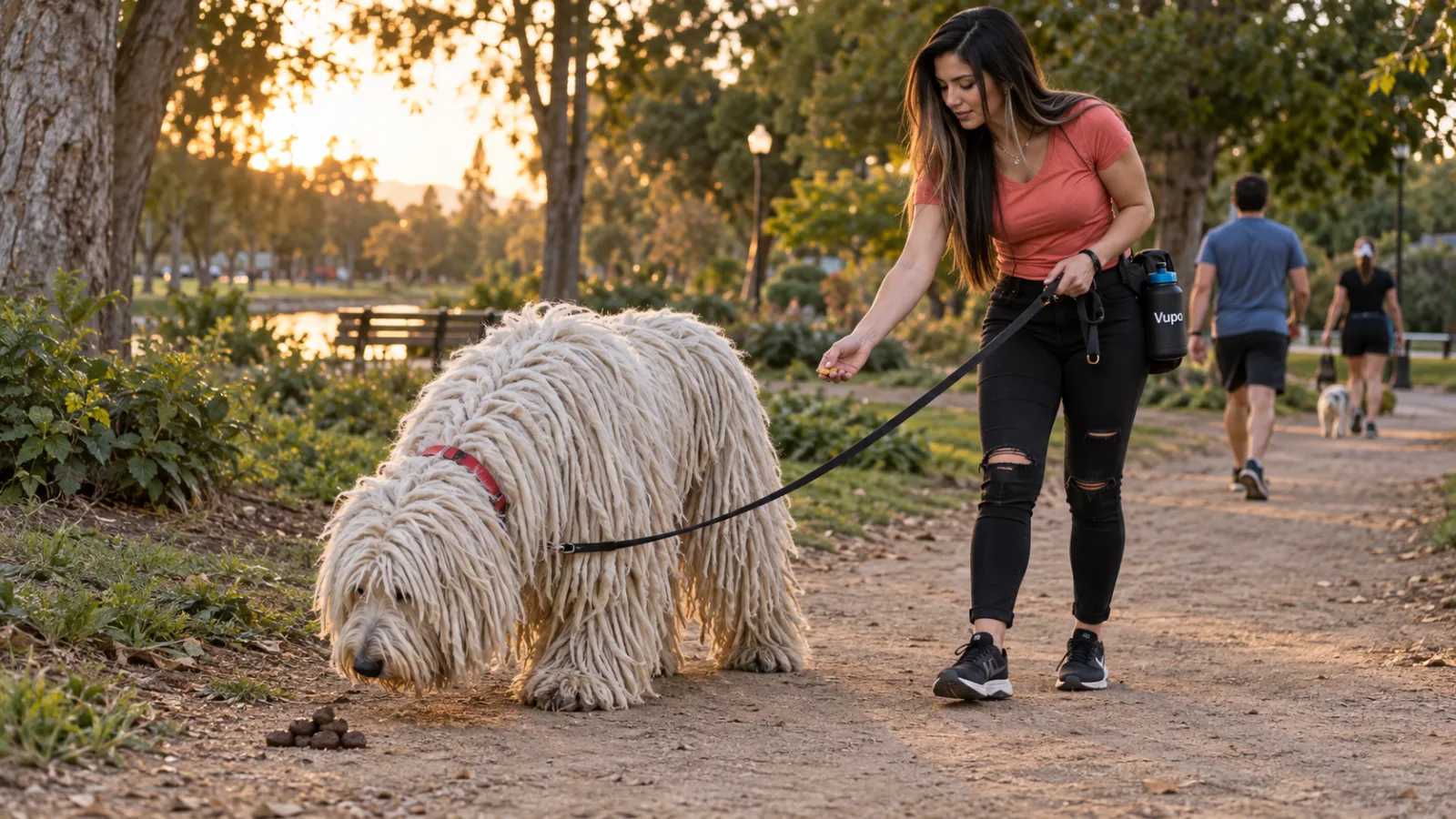
- Keep your dog on leash while it is eliminating.
- As soon as the dog finishes, call it to you and reward it.
- While the dog is eating the reward, pick up the stool.
- In a private yard, remove feces frequently and do not leave stool available.
- In homes with cats, place the litter box where the dog cannot reach it.
The goal is simple: do not give the dog repeated opportunities to practice the behavior.
2. Teach a Strong "Leave It" Cue
It is useful to separate two different skills:
- "Leave it" means the dog sees something and does not pick it up.
- "Drop it" means the dog already has something in its mouth and releases it.
For coprophagia, "leave it" is usually the more important skill.
Start indoors with food in a closed hand. When the dog stops trying to get the food and moves away, mark the behavior and reward from your other hand.
Later, practice with food on the floor, then outdoors, and eventually around more difficult distractions.
Do not begin training next to real feces. Build a strong response in easier situations first.
3. Create a Predictable Post-Potty Routine
Use the same sequence every time:
Dog eliminates -> you call the dog -> the dog comes to you -> the dog receives a high-value reward -> you pick up the stool.
With repetition, the dog learns that the best thing to do after eliminating is to turn toward you instead of going back to the feces.
4. Coprophagia Supplements, Digestive Enzymes, and Pineapple
There are many products marketed as a supplement to stop dogs from eating poop. These products usually claim to make the stool less appealing.
There are also home remedies, including adding pineapple to the dog's food.
The scientific evidence supporting these approaches is weak. In a large study that also evaluated commercial anti-coprophagia products, reported success rates were very low.
There is also no strong scientific evidence that pineapple reliably stops coprophagia.
Digestive enzymes may be appropriate if a veterinarian diagnoses a digestive or absorption problem that requires them. They should not be given automatically to every dog that eats feces.
When Should You See a Veterinarian?
Schedule a veterinary examination if the behavior begins suddenly in an adult dog, especially if you also notice:
- Weight loss
- Excessive hunger
- Diarrhea or vomiting
- A major change in stool amount or consistency
- Weakness
- Signs or suspicion of intestinal parasites
In these cases, a medical cause should be ruled out instead of relying only on training.
Frequently Asked Questions
Is eating poop dangerous for dogs?
It can be, especially when the dog eats feces from other animals or from contaminated environments. Dogs may be exposed to intestinal parasites and infectious organisms.
Does fresh pineapple really stop a dog from eating its own poop?
There is no strong evidence that pineapple reliably solves coprophagia. Environmental management, training, and veterinary evaluation when needed are more useful approaches.
Why does my dog specifically eat cat poop?
Many dogs are attracted to the smell and taste of cat feces. This is usually a scavenging behavior and not proof of a protein or vitamin deficiency.
Does it mean I am not feeding my dog enough?
Not necessarily. Dogs that receive an appropriate amount of food may still eat feces. However, unusual hunger or weight loss should be evaluated by a veterinarian.
What should I do if my puppy eats its poop immediately after eliminating indoors?
Do not punish the puppy. Stay nearby, call the puppy to you immediately after it finishes, reward it, and keep it away while you clean the area. At the same time, continue a consistent house-training plan.
Summary
If you are trying to figure out how to stop a dog from eating poop, do not look for one miracle trick. In most cases, the best approach combines environmental management, a reliable "leave it" cue, rewards for moving away from feces, and veterinary evaluation when there are signs of a possible medical problem.
The most important rule is to stop the dog from repeatedly practicing the behavior. The less often the dog gains access to feces, and the more rewarding the alternative behavior becomes, the better the chance of long-term improvement.
Professional Sources
Dog Training and Behavior
- RSPCA - Teaching a Dog to "Leave"
- Karen Pryor Clicker Training - "Leave It" and Foundation Skills
- Pet Professional Guild - Compulsive Eating in Dogs
- American Kennel Club - Why Dogs Eat Poop and How to Stop It
Veterinary Medicine
- VCA Animal Hospitals - Dog Behavior Problems: Coprophagia
- Merck Veterinary Manual - Behavior Problems of Dogs
- Companion Animal Parasite Council - Giardia
- Companion Animal Parasite Council - Ascarids
- Israel Companion Animal Veterinary Association - Spirocerca lupi
- Hart BL et al. The Paradox of Canine Conspecific Coprophagy. Veterinary Medicine and Science, 2018