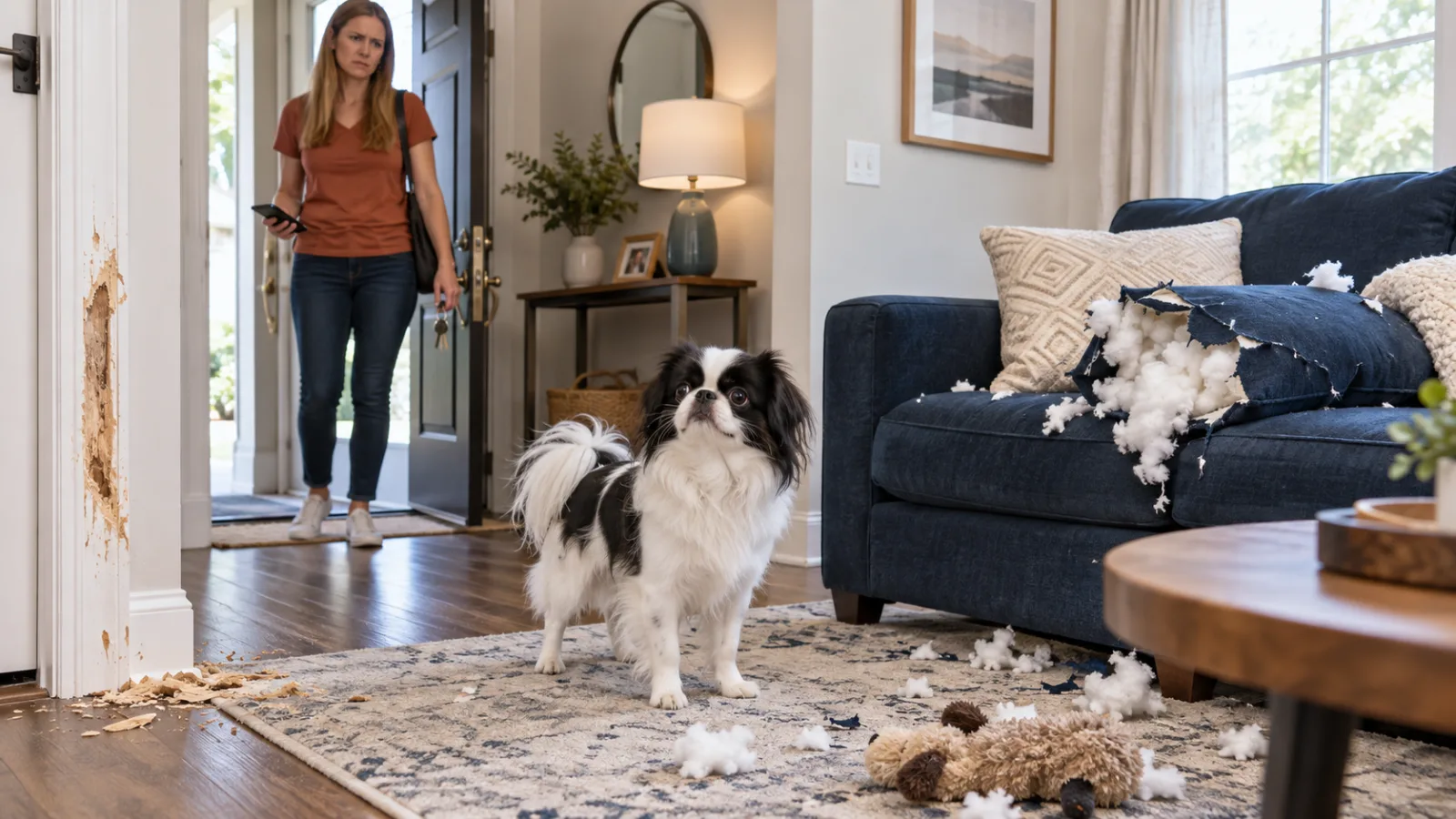
You come home and find a torn couch, a chewed door frame, or a damaged electrical cord. It is easy to get angry and think your dog “did it on purpose.” But when a dog destroys furniture when left alone, the damage is usually a symptom of an unmet need: normal chewing, boredom, frustration, difficulty being left alone, or true separation-related distress.
The solution does not start with the furniture. It starts with understanding why your dog is destroying it.
Find the Root Cause: Why Is Your Dog Chewing the House?
The Natural Need to Chew
Chewing is normal dog behavior. Puppies use their mouths to explore the world, and the urge to chew can increase during teething. Adult dogs also enjoy chewing as an activity on its own. It can provide mental engagement and may help reduce boredom or mild stress.
That is why the goal is not to make your dog “stop chewing.” The goal is to teach your dog what is appropriate to chew.
If your dog chews furniture even when you are home, especially when safe alternatives are not available, the problem may simply be that a natural behavior is being directed at the wrong objects.
Source: ASPCA - Destructive Chewing
Chronic Boredom and Frustration From Too Little Enrichment
A dog that does not get enough physical activity, sniffing, play, problem-solving, and interaction may create its own entertainment. From the dog’s point of view, tearing apart a pillow or chewing a table leg can be very interesting.
But it is important not to fall into the “just tire the dog out” trap. Exercise helps, but there is no magic number of minutes that works for every dog. A young, active dog may need a combination of walking, sniffing, short training sessions, and food-based enrichment. Another dog may need less physical exercise and more mental activity.
You can use Vupo to log walks and review your walk history over the week, then compare activity on days you found damage with days you did not.
Destruction Caused by Separation Anxiety
This is where you need to separate boredom from distress.
A dog with a separation-related problem may destroy things near doors, windows, gates, or other exit points. You may also see barking, howling, panting, drooling, pacing, escape attempts, or house soiling.
Timing is also important. If the destruction starts soon after you leave and happens mainly when you are away, separation-related distress should be considered.
A home camera is one of the best ways to start evaluating this. Watch the first part of your absence and look for restlessness, vocalization, repeated pacing, escape attempts, or refusal to engage with a food toy your dog normally enjoys.
For more information on Vupo: Separation Anxiety in Dogs.
Immediate Environmental Management: Limit Access and Protect Belongings
Protect Electrical Cords and Small Objects
Before training begins, reduce the risk.
Electrical cords should be hidden, raised, or protected with an appropriate cord cover. Shoes, remote controls, children’s toys, socks, and other small items should be kept out of reach.
This is not “giving in” to the dog. Good management prevents the dog from practicing the unwanted behavior again and again, and it reduces the risk of swallowing fabric, rubber, plastic, or wood.
If your dog swallows a non-food object or chews something that may be toxic, contact a veterinarian.
Use a Safe Area or Limit Access to Rooms
A safe room, baby gate, or puppy pen can help limit access to furniture and other items. The area should be familiar and comfortable. It should not be a place where the dog is sent as punishment.
A crate is not an automatic solution for an adult dog that destroys the house. If the dog panics when confined, the dog may try to break out and injure the mouth, teeth, nails, or paws.
If your dog is relaxed in a crate and has been introduced to it gradually and positively, it may be useful for appropriate periods of time. If the dog tries to escape, bites the bars, or panics, stop and use a different management option.
Source: VCA - Destructive Chewing
Redirect the Behavior: Give the Dog a Better Chewing Target
Safe Chew Toys
Choose chew toys that match your dog’s size and chewing strength. A durable rubber toy that can be filled with food and frozen can provide useful, long-lasting enrichment.
Be cautious with extremely hard items. Bones, antlers, hooves, and some hard nylon chews can cause tooth fractures. A practical rule of thumb is to avoid items that are so hard they do not have any give at all.
A product marketed as “durable” is not indestructible. If your dog can tear pieces off a rubber toy and swallow them, that toy is not safe for unsupervised use.
Sources: VCA - Fractured Teeth in Dogs, VCA - How to Choose the Best Chew Toy for Your Dog
Food Search Games and Enrichment Feeding
Instead of serving every meal in a bowl, use part of your dog’s food for mental enrichment.
For example:
- Scatter part of the meal in a safe room and let your dog search for it.
- Fill an appropriate rubber toy with suitable food and freeze it.
- Do 3-5 minutes of simple training, scent work, or hand-targeting before you leave.
The goal is not to exhaust your dog. The goal is to provide appropriate outlets for movement, sniffing, chewing, and problem-solving.
For more information on Vupo: Scent Games and Mental Enrichment for Dogs.
The Biggest Mistake: Why Getting Angry Afterward Does Not Help
You come home, see the damage, and get angry. From your point of view, the reason is obvious. From your dog’s point of view, the chewing may have happened minutes or hours earlier.
Yelling when you get home does not teach the dog what to do differently while you are away. If separation-related distress is involved, punishment can make the situation worse.
The dog may learn that your return predicts tension and conflict.
That is why there is no benefit in showing the dog the damaged door frame, yelling, or punishing after the fact. Focus instead on prevention, management, appropriate chewing outlets, and treatment of the underlying cause.
Frequently Asked Questions
Does My Dog Destroy Furniture “Out of Revenge” Because I Left?
No. Explanations such as normal chewing, boredom, frustration, difficulty being alone, or anxiety are much more useful for understanding the behavior.
A dog that destroys the house does not need to “learn a lesson.” You need to identify what caused the behavior and change the conditions around it.
Why Does My Dog Chew the Wall or Door Frame? Is It a Vitamin Deficiency?
Not necessarily. A door frame is easy to reach, has an interesting texture, and may also be close to an exit.
If your dog also eats non-food materials, the behavior appeared suddenly, or there are other medical signs, talk to your veterinarian.
Should I Leave Dental Chews or Bones With My Dog While I Am Away?
Only leave an item that is appropriate for your dog and that you have already seen your dog use safely.
No chew is 100% risk-free. Avoid extremely hard items and anything your dog can break into pieces and swallow.
Is a Crate a Good Solution for an Adult Dog That Destroys Furniture?
Only if your dog is already comfortable and relaxed in the crate and has been introduced to it in a positive way.
A crate is not a treatment for separation anxiety. If your dog tries to escape from it, confinement may increase distress and can lead to injury.
How Much Exercise Does My Dog Need in the Morning to Sleep Quietly All Day?
There is no single number of minutes that works for every dog.
Age, health, breed, temperament, and arousal level all matter. Think in terms of a balanced combination of walking, sniffing, short training, and mental enrichment instead of a fixed exercise target.
The Bottom Line
When a dog destroys furniture when left alone, do not start with punishment or bitter spray. Start with diagnosis.
Look at when the destruction begins, what your dog destroys, whether signs of distress are present, and how much physical and mental activity the dog gets on a normal day.
Then work on three things at the same time: protect the home, provide safe chewing alternatives, and address the real cause.
If a camera shows significant distress when you leave - such as prolonged vocalization, heavy panting, repeated pacing, escape attempts, or intense destruction around doors - contact your veterinarian and a qualified behavior professional who uses reward-based methods.
At that point, you are dealing with more than a “bored dog.” The problem needs a structured treatment plan.