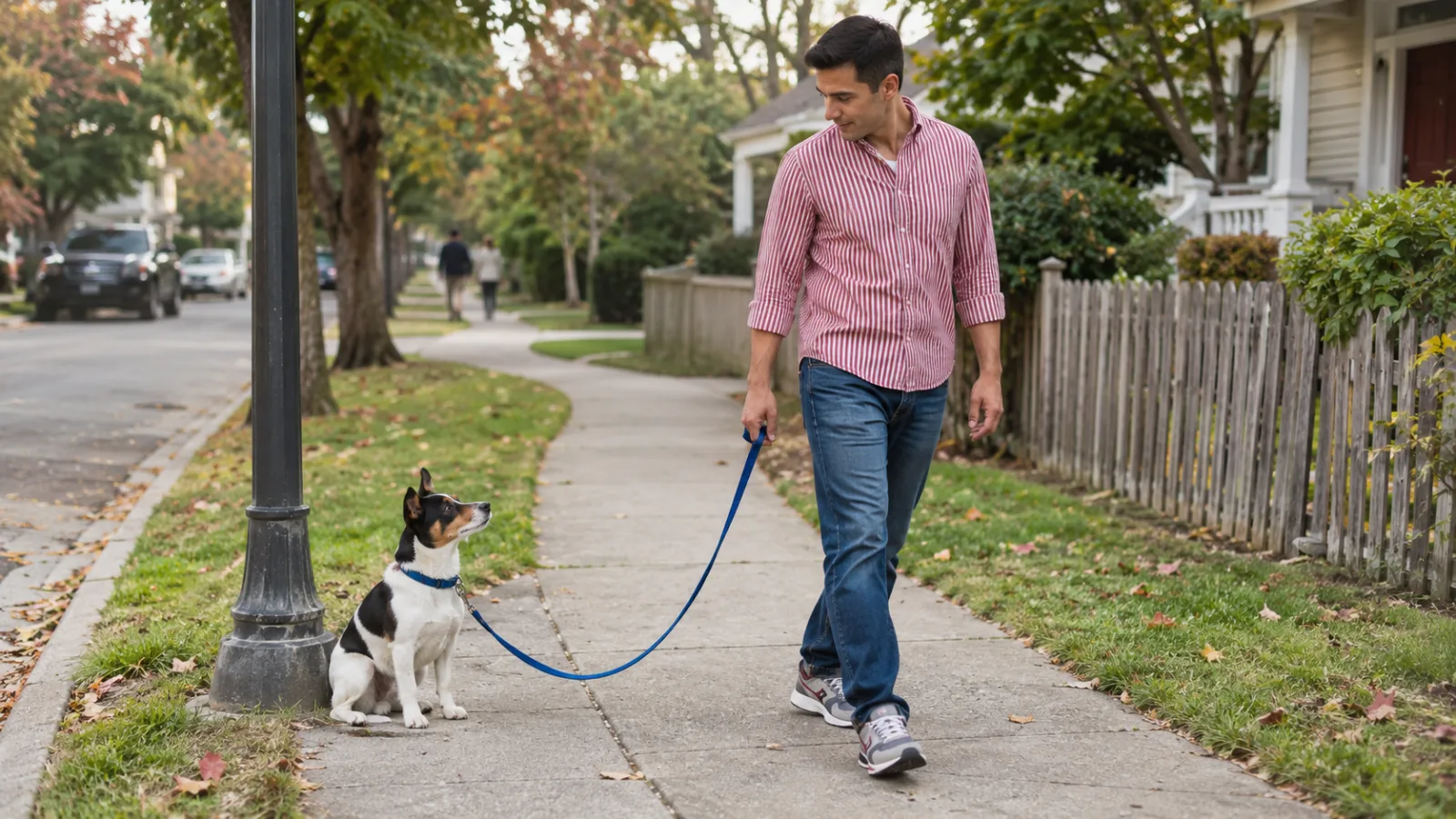
Your dog suddenly stops during a walk. Calling their name doesn't help. Should you wait, encourage them, or head home?
First, consider why your dog stopped.
For mild hesitation, invite them to move. For significant fear, reduce pressure and create distance. If you suspect pain or illness, stop and seek veterinary advice. Never drag your dog.
Consider their emotional and physical state, surroundings, and safety. Not every stop is a fear-related freeze. Dogs also stop to sniff, watch, rest, or avoid discomfort. Freezing can be a defensive response to a perceived threat.
Why Does Your Dog Stop Walking? Start With Body Language
Mild Hesitation or an Interesting Smell
A mildly hesitant dog may have a fairly loose body, move their ears, glance between you and their surroundings, and respond to a familiar cue. A dog following a scent may keep their nose down while shifting position and exploring.
Don't immediately label this stubbornness. Sniffing is part of a walk. If it's safe, allow some exploration before asking to move on. Stopping on the way home doesn't prove your dog is trying to control you.
Fear, Overwhelm, or Physical Discomfort
Stiffness, crouching, a tucked tail, pinned-back ears, trembling, fixed staring, or panting unrelated to heat or exercise can signal distress. Some frightened dogs stand tall and alert.
Look at the whole picture. A wagging tail doesn't guarantee comfort. Pupil size changes with lighting. Taking treats doesn't rule out fear, and refusing them can also reflect fullness or nausea. These clues guide your response; they don't provide a diagnosis. [1]
| What you notice | What to do |
|---|---|
| Loose body, exploration, response to a familiar cue | Pause briefly, then invite voluntary movement, while using the leash intermittently |
| Stiffness, trembling, attempts to retreat, difficulty responding | Reduce pressure and create distance |
| Limping, weakness, pain, or a sudden behavior change | Stop exertion and seek veterinary advice |
Mild Hesitation: Encourage Your Dog to Walk
Stay Calm and Invite Movement
Stand slightly beside your dog, keep the leash loose, and say "Let's go" once in a friendly voice. Take a small step in a direction they seem comfortable with. Praise and reward them when they join you voluntarily. Reward one step initially, then two or three.
Research on social referencing found that adult dogs use emotional information from their owners when facing an unfamiliar object. This suggests that staying calm may help. It doesn't prove that walking forward always reassures a puppy or that pausing teaches them to fear something. [2]
Walk Around the Object
If a trash bag or unfamiliar trash can causes hesitation, try a curved path that gives it more space. There's no fixed distance. A few feet may help one dog and be insufficient for another.
Continue only if your dog joins you and stays relatively loose. If they stiffen or stop again, increase the distance.
Take Small Steps With Puppies
Puppies discovering the outdoors may need short outings in quiet places. Invite your puppy to follow, without pulling them forward.
If the leash tightens and your puppy stays behind, pause and make things easier. Dogs may brace against leash pressure, but calling this an innate "opposition reflex" doesn't explain every case. Fear, discomfort, and previous learning can also contribute.
Fear or Overwhelm: Help Your Dog Feel Safer
Reduce Pressure and Allow Retreat
Loosen the leash as much as you safely can while keeping your dog secured. Stand beside them instead of looming over them or pulling continuously. Leash tension can restrict movement and add discomfort. It isn't a universal signal of danger.
If the setting is safe and your dog isn't becoming more distressed, allow a brief pause. There's no required 30-60-second waiting period. Move away sooner if tension increases or the frightening thing approaches. A fixed countdown doesn't guarantee that the brain will register safety.
Turn around, take a quieter side street, or cross at a safe location. Avoid moving closer to whatever frightens your dog. If they stop in the street, reaching safety comes first. Use the gentlest assistance that gets you both out of danger. [6]
Offer Treats or a Familiar Hand Target
Scatter a few treats on a clean, safe surface away from the trigger. Alternatively, offer a familiar hand target, where your dog touches your palm with their nose.
If they don't respond, stop repeating the cue. Don't lure them toward something frightening. Create more space. These tools may help, but they aren't a guaranteed way to end a freeze.
Forcing prolonged, intense exposure without an escape option can worsen fear. This is why flooding should be avoided. Later training should use gradual exposure at a level your dog can handle. Moving forward isn't automatically flooding; intensity, duration, and the ability to retreat matter. [3]
Pain, Prevention, and a Better Walking Routine
When to Call Your Veterinarian
Don't look only for frightening objects. Pain, fatigue, heat, or uncomfortable equipment can also cause stopping. Gently check paws and harness fit for injuries, rubbing, or restricted movement. Don't probe wounds or remove deeply embedded objects.
New or repeated reluctance to walk, limping, or sensitivity to touch warrants a veterinary exam. Pain can occur without obvious limping. [4]
Collapse, difficulty breathing, confusion, or marked weakness requires urgent veterinary care, especially in hot weather. Don't try to finish the route. [5]
Reduce Problems on Future Walks
Choose comfortable weather and routes suited to your dog's age, fitness, and confidence. Practice "Let's go" and hand targeting in quiet settings. For recurring fear, work with a qualified reward-based professional.
Note when stopping occurs: near an intersection, after a certain distance, or around other dogs. Notes can reveal patterns.
Use Vupo's walk reminders to support a routine. Track walk duration, distance in miles, and your walking streak. Adjust goals to your dog. A short, comfortable outing still counts. Never extend a walk just to protect a streak.
Frequently Asked Questions
Should I Pull the Leash if My Dog Won't Move?
Avoid dragging or leash jerks. Invite voluntary movement. If your dog doesn't join you, check for fear, discomfort, and environmental challenges.
Does Taking a Treat Mean My Dog Isn't Scared?
No. Dogs can eat while stressed. Also assess posture, breathing, and their ability to look away and explore.
Can I Comfort a Frightened Dog?
Yes. Speak calmly and offer closeness if they seek it. Comforting your dog doesn't require staying near the frightening thing.
What if My Puppy Sits Down Every Few Feet?
Shorten the outing, allow observation, and check for fatigue or uncomfortable equipment. Persistent difficulty deserves veterinary and training advice.
Why Does My Dog Stop Only When We're Heading Home?
First check for pain or fear along the route. Allow planned sniffing breaks, reward a familiar walking cue, and offer something enjoyable at home.
When Should I Get Professional Behavior Help?
Seek help when stopping recurs, fears spread, or walks become a struggle. Start by ruling out medical problems, then build an individualized plan.
Sources
- AAHA: Common Signs of Anxiety/Distress - Body-language indicators of anxiety and distress.
- Merola et al., 2012: Dogs' Social Referencing Towards Owners and Strangers - Research on adult dogs' use of emotional information from people.
- AAHA: Changing Behaviors - Desensitization, counterconditioning, and the risks of flooding.
- AAHA: Common Pet Pain Signs - Reluctance to move and behavior changes as possible signs of pain.
- Cornell University College of Veterinary Medicine: Summer Heat Safety Tips for Dogs - Warning signs of heat-related illness.
- Dogs Trust: Helping Dogs Cope With Fear and Big Emotions - Creating distance, offering reassurance, and avoiding forced interactions.