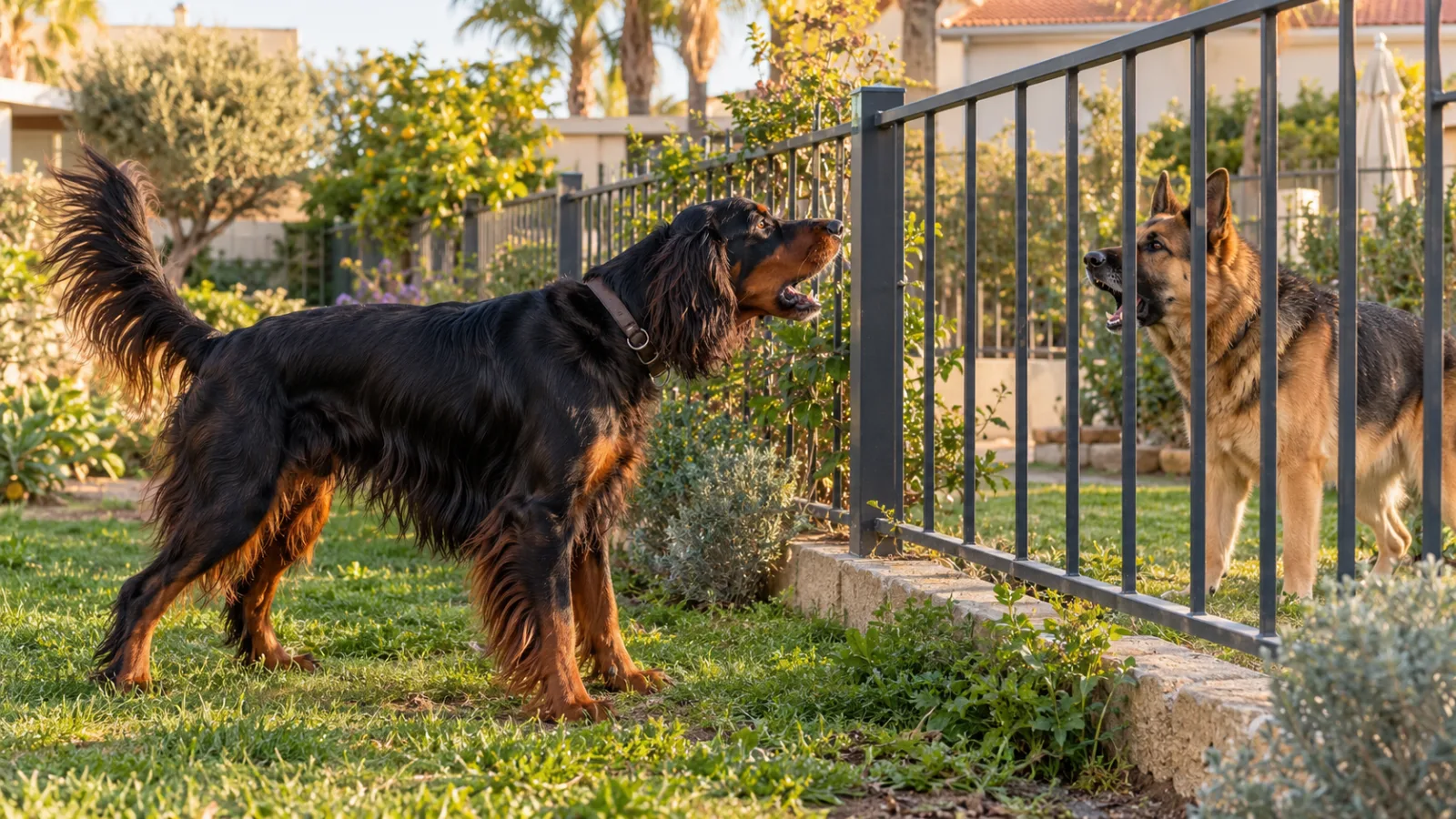
Your dog hears the neighbor's dog, races across the yard, and starts barking along the fence. You call her name, but she barely seems to notice. Within seconds, both dogs may be barking at each other.
The most useful goal is not to demand silence once your dog has become highly worked up. It is to prevent repeated barking episodes and teach a different response when she first notices the neighboring dog: turn toward you, move away from the fence, and earn something she values.
Why do dogs bark at fences?
A fence prevents normal movement and interaction. One dog may hear or smell another without being able to approach or retreat. This can produce barrier frustration, vigilance, fear, territorial responses, or excitement. Different dogs may bark for different reasons, and even one dog may have several motivations. Barking through a fence does not, by itself, prove that a dog is aggressive.
Repeated fence-line barking can become a familiar routine. The more often it happens, the harder it may be to interrupt. That is why management comes before training.
First, prevent rehearsals of fence barking
For now, do not send your dog into the yard alone when the other dog is likely to be outside. Take her out with you on a comfortable leash and well-fitted harness, keeping enough slack that she can move naturally. The leash is a safety measure, not a tool for jerking or correcting her.
If your neighbor is willing, agree on separate yard times during the initial phase. You could also install an opaque screen along the existing fence. A secure secondary barrier inside your property creates more distance; suitable dog-safe shrubs between barriers may provide additional visual screening. Keep plants, fence gaps, and access points safe. A visual screen can help, but a dog may still hear or smell the neighbor.
The objective is not permanent isolation. It is to stop the dog from practicing an intense reaction while you build a new habit. Provide normal walks, play, and mental enrichment away from the fence as well.
Prepare before you practice
Choose a time when the neighboring dog is in its yard but not barking intensely. Bring a clicker and a supply of small, high-value treats. First make sure your dog understands the clicker: in a quiet place, click once, give a treat, and repeat a few times. Each click should reliably predict a reward. A short marker word such as “Yes” can work, too.
Begin well back from the fence, where your dog can notice the other dog and still eat, move, and respond. This workable distance varies greatly; there is no universal number of feet. If the dog freezes, stares hard, barks repeatedly, lunges, or cannot take a treat, the setup is too difficult at that moment. Increase distance or reduce exposure.
Practice for a few minutes at a time. Several short, successful sessions are more useful than one prolonged confrontation.
Stage 1: Notice the other dog without barking
Stand with your dog at a comfortable distance. Watch her body language. She may raise an ear, turn her head, or briefly look toward the sound of the dog next door.
As soon as she notices the trigger while still able to stay calm, click and deliver a treat near you. The treat placement encourages her to orient toward you and away from the fence. This exercise pairs the other dog's presence with something pleasant while creating opportunities to reinforce disengagement.
Wait for another calm notice, then repeat. You do not need to provoke barking or move closer to speed up the process. If you clicked and your dog barked immediately afterward, still give the promised treat. Then adjust the next repetition: you may have marked too late, or the trigger may have been too intense. Aim to click for noticing or disengaging, not for the barking itself.
If she does not respond, do not keep clicking over an escalating outburst. Calmly create more distance and restart only when she can engage with you. Refusing food can be a sign that the situation is overwhelming, although food preference, satiation, and unfamiliarity with the marker can also play a role.
Stage 2: Reward the dog for checking in on her own
With repetition, many dogs begin to anticipate a treat after noticing the neighbor's dog. You may then see a useful change: your dog hears the sound and turns to you before you click.
Mark that voluntary head turn with a click and deliver a generous reward, such as several small treats one after another. You are now reinforcing a specific alternative behavior: I heard that dog, so I check in with my person.
Over time, you can add a familiar recall cue and reward moving toward you. Practice this skill in easy settings separately, rather than relying on a cue the dog cannot yet follow near the fence.
Increase difficulty one step at a time
Once your dog can repeatedly notice the other dog and turn to you with a relaxed body, make one small change at a time:
- Move slightly closer to the boundary, while keeping your dog comfortable.
- Practice when the neighbor's dog is moving or making mild noise, rather than completely still.
- Reward your dog for taking a few steps away from the fence to reach you.
- Gradually increase the distance she needs to travel back to you.
- Only in a secure yard, and after reliable success, consider supervised off-leash practice.
If barking, lunging, or fixation returns, reduce the difficulty. Progress is not a straight line, especially when the neighboring dog suddenly becomes more active. Keep using food rewards often. Toys or games may also be effective if your dog enjoys them; praise alone is not equally reinforcing for every dog.
A practical progress measure is the proportion of manageable encounters in which the dog notices the neighbor and voluntarily checks in, rather than the number of days on a calendar. Improvement can take weeks or longer and varies by dog.
Common mistakes to avoid
Waiting for a barking fit before acting. It is easier to reinforce calm noticing than to interrupt a dog who is already overwhelmed.
Moving too close too quickly. Being able to eat treats is useful information, but it does not guarantee the dog is fully relaxed. Look at her entire body and behavior.
Clicking repeatedly during barking. The marker should identify a moment you want to reinforce. If a click happens, honor it with a treat, then improve your timing next time.
Punishing or shouting at the dog. Adding an unpleasant experience around another dog can increase distress and does not teach the alternative response.
Assuming a meeting will fix it. Some neighbor dogs may do well on carefully managed parallel walks away from the fence, but a face-to-face greeting is not automatically safe or necessary.
When to seek professional help
Ask a qualified reward-based behavior professional for an individual plan if your dog tries to bite through the fence, redirects onto a person or another dog, cannot settle even at a large distance, or is getting worse. A veterinarian should assess sudden behavior changes or signs of pain or anxiety. Keep dogs securely separated while the risk is evaluated.
You can organize brief practice sessions with a structured training plan, including a plan in Vupo, and note which distances and distractions your dog can handle. The important part is recording observable behavior, not expecting perfectly quiet behavior overnight.
Frequently Asked Questions
Why does my dog only bark at the neighbor's dog through the fence?
A fence changes the interaction: dogs cannot freely approach, investigate, or move away. Barrier frustration, fear, vigilance, excitement, and territorial behavior are all possible. Watch the full context before deciding why your dog reacts.
Will a privacy fence stop the barking?
It may reduce visual triggers, especially when dogs rush at each other on sight. It cannot block sounds or scents, so many dogs still need a training plan.
What if my dog ignores the clicker and treats?
Increase distance, reduce the intensity of the setup, and check that your dog knows the click predicts food. Consider whether the treats are motivating. If the dog remains highly distressed, get professional help.
Do I have to use a clicker?
No. A consistent, previously trained marker word can identify the correct moment. The essential elements are clear timing, appropriate reinforcement, and manageable exposure.
When can my dog go into the yard off leash?
Only when the yard is secure, your dog can disengage consistently from the neighbor's dog, and you can supervise safely. Some dogs need long-term barriers or supervised access.
Should the two dogs meet?
Not necessarily. If both dogs are comfortable and their handlers can manage them safely, parallel walks away from the fence may sometimes help. Do not arrange direct greetings if either dog is showing serious aggression or distress.
Professional References
- AVSAB - Humane Dog Training Position Statement - reward-based training and environmental management.
- VCA Animal Hospitals - Introduction to Desensitization and Counterconditioning - controlled exposure and the importance of staying below the dog's reaction threshold.
- American Kennel Club - How to Stop Fence Aggression in Dogs - fence barriers, management, and training.
- American Kennel Club - Ask Our Trainers: How Can I Stop My Dog From Barking at the Neighbors? - alternative behaviors and supervised yard access.
- VCA Animal Hospitals - Barking in Dogs - assessment, management, and professional support.