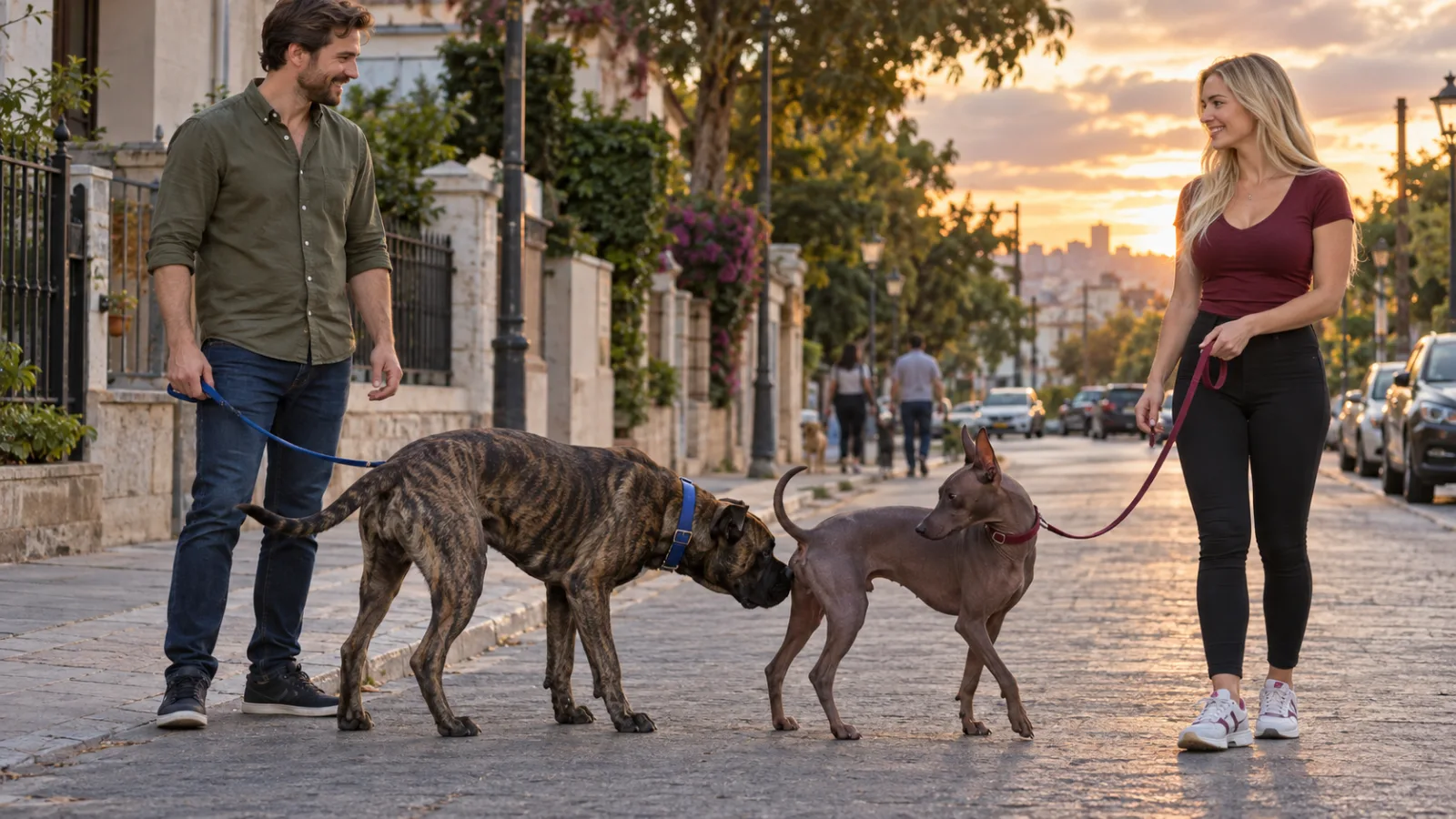
A first meeting between dogs can go wrong when they are brought together too quickly. If you are wondering how to introduce dogs the right way, the goal is not to make them “be friends” immediately. The goal is to create conditions where both dogs feel safe and can approach at a pace that works for them.
Success does not have to mean playing together. Sometimes a successful first meeting is simply two dogs walking calmly in the same area without tension.
Why Face-to-Face Leash Greetings Can Create Problems
Curved approaches vs. forced head-on greetings
Dogs do not always approach each other in a straight line. They may move in an arc, sniff the ground, pause, or look away before getting closer.
These behaviors can help reduce social pressure.
When two people stand still and pull their dogs toward each other on tight leashes, the dogs lose some control over distance and movement. A prolonged face-to-face greeting, especially with hard staring and stiff posture, can increase tension.
Always read the whole dog rather than judging one signal by itself.
Barrier frustration and leash tension
A leash does not cause aggression by itself, but it can limit movement. In an already excited or frustrated dog, that restriction can increase barking, pulling, lunging, or other reactive behavior.
When introducing dogs on leash, keep the leash as loose as safety allows. Give both dogs enough distance to look away, sniff the environment, and disengage from each other.
A 4-Step Protocol for a Safer Introduction
Step 1: Start on neutral territory
If you want to know how to introduce two dogs, start outside the home.
Choose a quiet street, open park, or other low-traffic area that is not strongly associated with either dog's food, resting area, or daily routine.
Avoid making the first introduction inside the resident dog's living room whenever possible. Starting on neutral ground reduces some of the pressure related to territory and valuable resources.
Ideally, have one adult handler for each dog.
Step 2: Use parallel walking
Parallel walking is one of the most useful tools for a first meeting between dogs.
Walk both dogs in the same direction without asking them to greet each other right away.
You can begin several yards apart. In some cases, starting around 20 feet apart is appropriate. If either dog is staring, pulling, barking, or unable to disengage, increase the distance.
Move closer only when both dogs look more relaxed. Good signs include sniffing the environment, looking away from the other dog, moving with a loose body, and being able to take treats.
Do not rely on a fixed time limit. Ten to fifteen minutes may be enough for some dogs, while others may need several walks before they are ready for closer contact.
Use body language, not the clock, to decide when to move forward.
Step 3: Decrease distance gradually and allow a brief sniff
Once both dogs are calm, gradually reduce the distance between them.
Do not pull them directly nose-to-nose. Instead, keep moving and allow a curved approach when possible.
If both dogs choose to greet, allow a short sniff of a few seconds.
The commonly used “three-second rule” can be a helpful management guideline, but it is not a scientific law. After a few seconds, call the dogs apart, continue walking, and reassess their body language.
If both dogs choose to approach again with loose, relaxed bodies, you can allow another short interaction.
Step 4: Enter the home with careful resource management
If the dogs will be living or spending time together in the same home, enter only after they have had a calm walk together.
At first, remove high-value items that could create competition. This may include bones, food-filled toys, chews, and food bowls.
Feed the dogs separately and give each dog a separate resting area.
You do not need to remove every object in the house automatically. However, if either dog has a history of resource guarding, manage access to toys, resting areas, food, and other valued items carefully.
Reading Body Language in Real Time
Signs that the dogs are coping well
Look for loose movement and soft body language.
Positive signs may include:
- Curved approaches
- Looking away
- Sniffing the ground
- Soft blinking
- Shaking off after a mildly tense moment
- Play bows
Healthy play often includes role reversals and pauses. One dog may chase and then become the dog being chased. One dog may stop, and the other dog should be able to respect that pause.
A wagging tail alone does not mean a dog is friendly, happy, or relaxed. Always look at the dog's entire body.
Warning signs that the introduction is not going well
Signs that the dogs may be uncomfortable include:
- A stiff body
- Freezing
- Hard, prolonged staring
- Blocking the other dog's path
- Lip lifting or showing teeth
- Threatening growling
- Repeated attempts to move away
- A high, stiff tail combined with a tense posture
If one dog freezes, do not wait to “see what happens.” Calmly create more distance.
Special Situations: Introducing an Adult Dog to a Puppy
How to introduce an adult dog to a new puppy
Puppies can be socially intrusive. They may jump on adult dogs, mouth them during play, or ignore signals asking for space.
An adult dog may growl, turn away, walk off, or give another mild warning. These can be normal ways of setting boundaries.
Do not punish a growl. A growl gives useful information that the dog is uncomfortable.
At the same time, do not expect the adult dog to “teach the puppy a lesson.” If the puppy keeps pestering the adult dog, step in and give the adult dog a break.
Separate the dogs if you see threatening pursuit, repeated pinning, biting, or an inability to disengage.
Rolling onto the back does not automatically mean “submission.” It can occur during play, appeasement, or stress. Context matters.
What about dogs of the same sex?
There is no universal rule that same-sex dogs will fight.
Compatibility depends on the individual dogs, including their temperament, age, history, arousal level, previous social experiences, and behavior around resources.
If either dog has a known history of serious aggression toward other dogs, do not conduct a trial introduction without help from a qualified behavior professional.
Managing Resource Guarding During the First Few Days
Dogs may guard food, chews, toys, beds, resting areas, or sometimes access to people.
During the first few days:
- Feed the dogs separately.
- Give high-value chews and food toys only when the dogs are separated.
- Do not forcibly take an item from a dog that is guarding it.
- Supervise hallways, doorways, couches, and other areas where space may become tight.
- Give each dog regular time alone.
Good management reduces opportunities for conflict. The dogs should not be expected to “work it out” over valuable resources.
Common Mistakes to Avoid
Do not push two unfamiliar dogs nose-to-nose because they “need to say hello.”
Do not force a greeting.
Do not punish growling.
Do not bring a new dog directly into the resident dog's home and simply hope they will sort things out.
Also avoid using punishment-based methods to stop tension between dogs. Fear, pain, or intimidation can make social conflict worse.
If either dog also struggles with leash reactivity or pulling, it can help to work on those issues separately before attempting close greetings.
To learn more, read our guides to loose-leash walking, leash reactivity, and dog parks and canine body language.
How Vupo Can Help Before the Meeting
With the Vupo community, dog owners can connect with nearby dog owners, reach out to them, and review details such as breed, age, sex, and sociability when an owner has chosen to share them.
Details such as breed, age, sex, and sociability can help owners plan a more appropriate first interaction.
This information cannot guarantee compatibility. However, it can make it easier to arrange a controlled parallel walk instead of relying on a random, crowded greeting.
FAQ
How long should the parallel walk last before the dogs are allowed to sniff each other?
There is no fixed time.
Ten to fifteen minutes may be enough for two relaxed dogs, but other dogs may need several walks before they are ready for closer contact.
Move forward based on body language, not the clock.
What should I do if one dog growls during the introduction?
Do not punish the growl.
Growling is communication and a warning that the dog is uncomfortable. Increase distance, reduce pressure, and return to parallel walking at a distance where the dog can relax.
Why should I avoid introducing unfamiliar dogs inside the home first?
The home contains valuable spaces, familiar smells, resting areas, food, and other resources.
Starting on neutral territory usually creates less social pressure and gives both dogs more freedom to move away.
Should I remove all toys before the new dog comes inside?
At first, remove high-value items, especially if either dog has a history of resource guarding.
You do not need to treat every toy as dangerous. The goal is to reduce competition until you understand how the dogs behave around shared resources.
What should I do if the adult dog corrects the puppy harshly?
A brief growl, turn-away, or other mild warning may be normal communication.
If the adult dog continues chasing, pinning, biting, or cannot disengage after the puppy backs away, separate the dogs and get help from a qualified professional.
Professional Sources
- Best Friends Animal Society - How to Introduce Dogs to Each Other
- Best Friends Animal Society - Food Aggression and Resource Guarding in Dogs
- VCA Animal Hospitals - Introducing a New Dog to Your Family Dog
- ASPCA - Aggression in Dogs
- American Kennel Club - Understanding Dog Body Language
- American Kennel Club - Why Dogs Growl and How to Respond
- American Veterinary Society of Animal Behavior - Position Statements