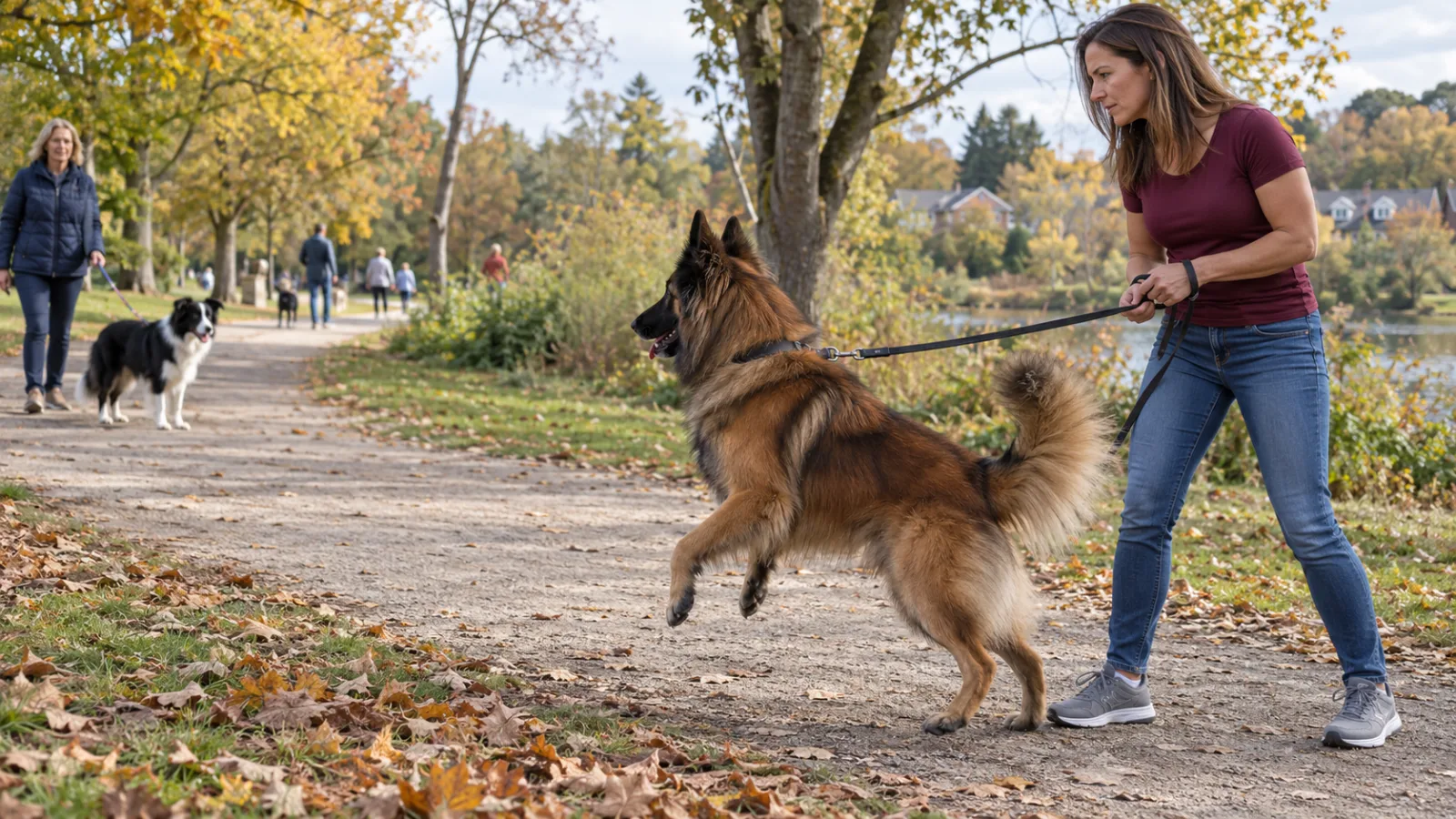
Your dog spots another dog across the park. Suddenly, walking calmly is forgotten. He pulls, bounces, whines, or races toward the newcomer. You may be certain that he only wants to say hello, but the other dog has not agreed to that interaction.
A dog who becomes intensely excited about greeting others is sometimes called a frustrated greeter. The term describes a pattern, not a diagnosis. Some dogs are eager to socialize but frustrated when they cannot reach another dog. Others bark or lunge because they are frightened, uncertain, or trying to create distance. The correct training plan depends on the reason for the behavior.
The goal is not to make your dog dislike other dogs. It is to teach him that spotting one does not automatically mean rushing over. He can notice a dog, reconnect with you, and sometimes earn a calm, appropriate greeting.
Why greetings become difficult
Friendly intent does not guarantee a friendly impact. Running directly into another dog's space can feel threatening, particularly to a shy, older, injured, or smaller dog. Even a dog who enjoys play may not want contact at that moment.
Watch for loose, flexible movement, the ability to pause, and mutual willingness to engage. Stiff posture, prolonged staring, retreating, repeated attempts to escape, or escalating tension are reasons to stop the interaction. Avoid assuming that barking and lunging always mean enthusiasm.
First, prevent unwanted practice
For now, stop allowing surprise greetings on walks. Cross the street, turn onto a quieter route, or use a park with space to move away. If your usual route is crowded, travel to a quieter walking location when practical.
This is management, not failure. Every uncontrolled rush gives your dog another chance to practice the behavior you are trying to change. You do not need to make your dog greet unfamiliar dogs to improve his social skills.
A leash can restrict movement and make greetings awkward, but not every on-leash greeting is inherently harmful. The key is whether both dogs remain comfortable, the leashes stay slack, and the owners can manage the encounter. During early training, avoiding spontaneous greetings is usually simpler and safer.
Teach your dog to notice and check in
Choose a spot where other dogs pass at a distance. Bring small, high-value treats and, if you use one, a clicker. A brief marker such as “yes” works too. First teach your dog that the marker predicts a reward.
Step 1: Notice a dog, earn a reward
When your dog spots another dog, mark the moment with a click or “yes” and immediately offer a treat. Let the dog look; you are not trying to block the sight of the other dog.
Distance is the critical variable. Begin far enough away that your dog can notice the dog, move normally, and readily take food. If he freezes, stares intensely, barks, lunges, or cannot engage with the reward, calmly increase the distance. Refusing food can reflect several factors, but in this context it is an important sign that the exercise may be too difficult.
Use brief sessions and finish before your dog becomes overwhelmed. Repeat in several suitable locations, rather than forcing closer encounters.
Step 2: Reinforce the look back
With repetition, your dog may start to notice the other dog and then turn toward you in anticipation of a reward. Now mark and reward that voluntary glance back. This is an automatic check-in.
Do not demand eye contact while your dog is struggling. If the check-in stops happening, return to marking the initial look or increase distance. Progress by changing just one challenge at a time: slightly less distance, a moving dog, or walking past at an angle. Walking directly toward other dogs is a much harder step and is not necessary early on.
Rehearse with a familiar, suitable dog
When your dog can notice unfamiliar dogs and check in reliably at a comfortable distance, enlist a friend with a sociable, emotionally steady dog. Choose dogs that already have a good relationship and similar play styles. A tolerant dog should not be expected to absorb repeated rude or rough interactions.
Arrange a controlled session in a quiet, legally appropriate location. Start with both dogs separated by enough space to remain relaxed. Have the helper stop approaching if either dog becomes too excited. Your dog can be managed on a suitable, carefully handled long line where permitted, but never rely on stepping suddenly on a taut line to halt a sprint. Keep the line from wrapping around legs, and prevent the dog from building speed toward its end.
When your dog notices his friend, wait for a voluntary check-in or give a well-rehearsed recall cue. Reward the response. If both dogs are relaxed, both handlers agree, and the setting is secure, you may sometimes release your dog to greet or play. On other repetitions, reward with food, a toy, or a shared activity and move on.
This teaches an important distinction: checking in creates opportunities, but it does not guarantee access to every dog. Keep meetings short, interrupt play periodically, and only resume when both dogs voluntarily show interest.
Plan Playdates with Familiar Dogs Using Vupo
One way to help your dog learn to stay calm around other dogs is to arrange planned meetups with dogs they already know and get along with. With the Vupo app, you can coordinate meetups with familiar dogs at dog parks or during shared walks. This allows you to choose suitable playmates, agree on a convenient time and place, and create opportunities to practice calm, controlled greetings without relying on unpredictable encounters with unfamiliar dogs.
Build a skill you can use on real walks
Practice in different places with different levels of distraction. Monitor your dog's recovery after each sighting, not just whether he obeys a cue. A dog who can look, turn back, and continue walking without pulling is making meaningful progress.
Eventually, in a safe and legally permitted off-leash setting, a reliable check-in or recall can give you time to decide whether a greeting is appropriate. Off-leash practice is an advanced step, not a shortcut. Never use an unfenced public area to test an unreliable recall.
When to adjust the plan
If your dog repeatedly explodes into barking or lunging, increase distance and reduce difficulty. If you observe fear, snapping, fights, or any bite history, avoid planned dog-to-dog greetings until a qualified, reward-based behavior professional has assessed the situation. New or sudden behavior changes also warrant veterinary evaluation to check for pain or illness.
Progress is rarely linear. Measure success by calmer responses and better choices, not by the number of dogs your pet meets.
Frequently Asked Questions
Is a frustrated greeter an aggressive dog?
Not necessarily. Dogs may pull or bark because they are excited, frustrated, fearful, or distressed. Do not diagnose motivation from barking alone.
Should I let my dog greet every dog on leash?
No. Your dog does not need to meet every dog. Prioritize space, mutual willingness, and the option to pass without interacting.
What if my dog will not take treats?
Move farther away and simplify the exercise. If the dog continues to refuse food in many settings or shows sudden changes in behavior, consider veterinary advice.
Will visiting dog parks improve his manners?
Not necessarily. Busy dog parks can provide uncontrolled opportunities to rehearse rushing and chasing. Structured work with a suitable, familiar dog is often more manageable.
How long does training take?
There is no universal timeline. Learning history, motivation, environment, consistency, and emotional state all affect progress. Focus on observable improvement rather than a deadline.
Can playing with another dog be a reward?
Yes, for a dog who genuinely enjoys it, provided both dogs are willing, the context is safe, and play is not offered after every repetition.
Professional References
- American Veterinary Society of Animal Behavior (AVSAB). Humane Dog Training Position Statement. Guidance on reward-based training and welfare.
- Battersea Dogs & Cats Home. How to Deal With Lead Frustration. Managing distance and building alternate behavior.
- American Kennel Club. Leash Aggression in Dogs. Distinguishing frustration, reactivity, and aggression.
- American Kennel Club. Dog-to-Dog Greetings. Planned introductions and respecting canine preferences.
- IAABC Foundation Journal. Teaching Polite Play. Reading mutual willingness during play.
- Charleston Animal Society. Engage, Disengage. Practical illustration of the look-and-check-in exercise.
For more practical walking and training guidance, explore the Vupo Knowledge Center.