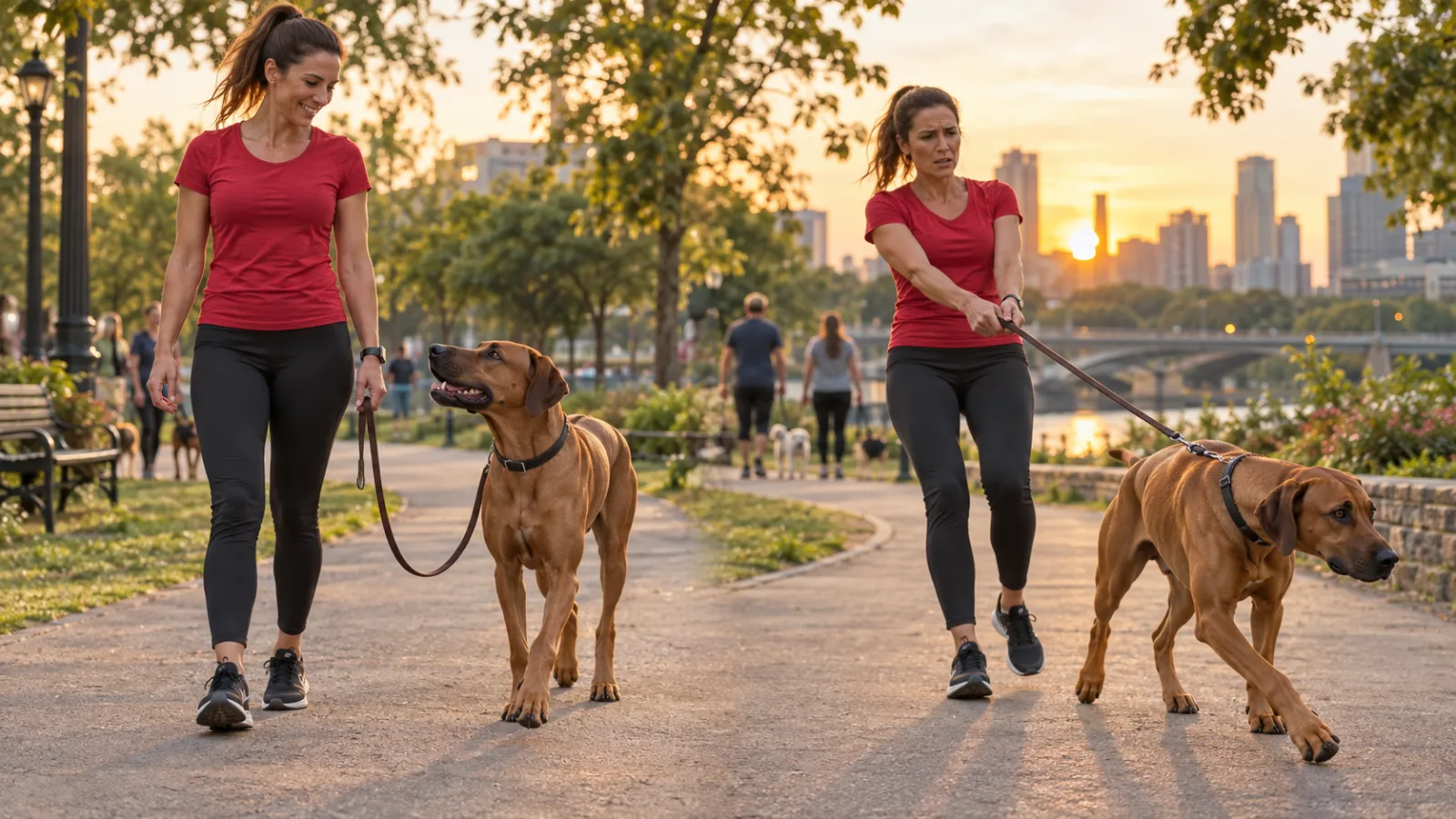
If your dog pulls on the leash, a simple daily walk can quickly turn into a frustrating struggle. In most cases, pulling is not a sign of stubbornness or an attempt to control you. Your dog has simply learned that pulling works: they want to reach a smell, another dog, a tree, or something interesting, they pull forward - and they get closer to it.
Loose-leash walking is one of the more challenging skills to teach because we are asking a dog to regulate their speed, excitement, curiosity, and reactions while moving through an environment full of distractions.
For that reason, especially if you have a strong dog, a reactive dog, or a dog with a long-established pulling habit, working with a qualified and experienced professional dog trainer is highly recommended.
Why Do Dogs Pull on the Leash? Understanding the Behavior
Opposition Reflex and Natural Differences in Walking Speed
What is often referred to as the opposition reflex is a dog’s tendency to push or move against physical pressure. When the leash tightens and creates backward pressure, many dogs instinctively lean or pull forward.
There is also a basic difference between the way humans and dogs naturally move through the environment.
Dogs do not typically walk at a steady human pace. They speed up, slow down, stop, sniff, investigate, change direction, and move toward things that interest them. Walking calmly at a person’s pace is therefore a learned skill rather than something dogs automatically understand.
Leash Frustration and Environmental Overstimulation
A dog may see another dog, a person, a squirrel, or another exciting stimulus and become frustrated because the leash prevents them from reaching it. This is often referred to as leash frustration or barrier frustration.
As a dog’s level of arousal increases, their ability to focus, respond to cues, and make calmer choices usually decreases.
That is why it is important to ask whether your dog pulls throughout the entire walk or mainly in specific situations, such as when approaching other dogs or exciting environments.
Choosing the Right Equipment: Collar, Front-Clip Harness, or Retractable Leash?
Equipment does not teach a dog how to walk politely on a leash, but the right equipment can make training easier, safer, and more manageable.
Why Retractable Leashes Can Make Training More Difficult
With a retractable leash, the available leash length constantly changes, and the dog often experiences ongoing tension on the line. This can make it harder for the dog to understand what a loose leash actually feels like and how far they are expected to remain from the handler.
When teaching loose-leash walking, a standard fixed-length leash is usually a better choice because it provides clearer and more consistent feedback.
The Benefits of a Y-Shaped Front-Clip Harness
A properly fitted Y-shaped harness with a front attachment point can be useful for managing a dog that pulls. A front-clip harness can reduce the dog’s mechanical advantage when pulling and also avoids concentrating leash pressure directly on the neck.
However, a no-pull or front-clip harness should not be viewed as a complete training solution. A poorly fitted harness may interfere with normal movement, and a dog that has never learned loose-leash walking can still develop or maintain pulling behavior while wearing one.
The equipment helps manage the behavior. Training changes the behavior.
A 3-Step Training Protocol: From a Quiet Home to a Busy Street
Step 1: Teach Attention and Movement Near You in a Low-Distraction Environment
Start indoors, in a yard, in a quiet parking area, or on a calm street with very few distractions. Walk a few steps and reward your dog whenever the leash remains loose.
At the beginning of training, rewards should be frequent. You want the dog to clearly understand which behavior is earning reinforcement.
The goal is not a formal competition-style "heel." Your dog does not need to remain glued to your leg. The goal is for the dog to learn how to stay within a comfortable range while keeping slack in the leash.
If you are wondering how to teach a puppy to walk on a leash, begin with very short sessions of about 2 to 5 minutes and keep the environment simple.
Step 2: Use the "Be a Tree" Method and Planned Direction Changes
When the leash becomes tight, stop moving forward. Do not pull the dog back toward you. Instead, remain still and wait for the leash to loosen. The moment the dog reduces tension, turns back toward you, or moves closer, continue walking.
You can also make planned changes of direction and reward the dog for noticing the change and following you.
The basic rule should be consistent: a tight leash does not move the dog closer to what they want. A loose leash allows the walk to continue. This is one of the most important principles in teaching a dog not to pull.
Step 3: Reinforce the J-Shaped Loose Leash
Look at the shape of the leash while walking. Ideally, the leash should hang down from your hand and curve gently toward the dog, creating a loose J-shape rather than forming a straight, tight line.
Whenever you see that loose J-shape, mark the behavior with a consistent word such as "Yes" and reward your dog. During the early stages of training, reinforce frequently. As the dog improves, gradually increase the number of steps between food rewards.
You can also start using natural rewards. For example, if your dog wants to reach a tree and sniff it, walking toward the tree on a loose leash can become the reward. This is often extremely effective because you are using what the dog already wants as reinforcement.
Include Mental Decompression Before and During the Walk
Sniffing and Decompression Walks
One of the most common mistakes in leash training is turning the entire walk into a strict obedience exercise. Dogs also need opportunities to sniff, explore, and process information from their environment.
Sniffing is an important form of mental enrichment and allows dogs to engage in a highly natural behavior. For many dogs, providing structured opportunities to sniff can also help reduce overall arousal and make the walk easier to manage.
Rather than expecting perfect leash behavior for the entire outing, divide the walk into different sections. For example:
- Allow several minutes of relaxed sniffing.
- Practice loose-leash walking for a short period.
- Return to relaxed exploration.
- Practice again when the dog is able to focus.
A walk does not have to look like a military obedience exercise to be successful.
Common Mistakes When Teaching Loose-Leash Walking
- Continuing to move forward while the dog is pulling, unintentionally rewarding the pulling behavior.
- Starting training in an environment that is far too distracting.
- Pulling or jerking the leash instead of teaching the dog what you want them to do.
- Waiting until the dog is already highly aroused before trying to regain their attention.
- Confusing loose-leash walking with a formal heel.
- Expecting too much progress too quickly.
- Using equipment as a substitute for actual training.
Frequently Asked Questions
Why Are Retractable Leashes Not Recommended for Dogs That Pull?
Retractable leashes create changing distances and often maintain tension on the leash. This can make it more difficult to establish a clear rule that walking forward happens when the leash is loose. During training, a fixed-length leash usually provides clearer and more consistent information.
How Long Does It Take to See Improvement in Leash Pulling?
Some dogs show noticeable improvement within the first week, but reliable loose-leash walking may take several weeks or even months.
Progress depends on the dog’s age, previous learning history, level of excitement outdoors, the environment, the consistency of the handler, and how well the training difficulty is managed. Consistency matters more than trying to fix the problem quickly.
Can Pulling on the Leash Cause Physical Problems?
Repeated strong pressure through a collar places force directly on the dog’s neck. This is particularly relevant for dogs that pull heavily or chronically.
If your dog coughs, gags, has difficulty breathing, appears uncomfortable around the neck, or shows signs of pain during or after walks, consult your veterinarian. Choosing appropriate equipment and addressing persistent pulling through training are both important.
What Should I Do If My Dog Locks Onto Another Dog and Starts Pulling Frantically?
Create distance before your dog becomes completely overwhelmed. Move farther away from the trigger, change direction, and reward your dog for disengaging and looking back at you.
This is where the concept of an arousal threshold becomes important. Once a dog is too close to a trigger and highly aroused, learning becomes much more difficult. If your dog’s behavior involves significant reactivity, fear, lunging, barking, or aggression, professional guidance from an experienced trainer or behavior professional is strongly recommended.
Will Using Treats on Walks Make My Dog Dependent on Food Forever?
No. During the learning phase, food rewards are used frequently because the dog is learning a new behavior. Once the behavior becomes more reliable, food rewards can gradually become less frequent and more unpredictable.
You can also replace some food rewards with praise, forward movement, access to interesting smells, and permission to explore. The goal is not to stop rewarding the dog completely. The goal is to build a behavior that can be reinforced in many different ways.
A Good Walk Is a Skill, Not a Test of Strength
The goal of leash training is not to force your dog to remain directly beside you for the entire walk. A successful walk allows your dog to explore the environment while still being able to move with you without constantly creating tension on the leash.
Teaching this skill takes patience, good timing, consistency, and careful management of distractions. Because loose-leash walking is one of the more technically demanding everyday training skills, getting help from a qualified and experienced dog trainer can significantly improve both the learning process and the results.
With Vupo, you can track your dog’s walk duration, distance, and walking streaks. Over time, this can help you compare different types of walks and better understand how combinations of exercise, sniffing, exploration, and training affect your dog’s behavior.
You may also want to read: "How Many Times a Day Should You Walk Your Dog?", "Dog Parks: Benefits and Safety Rules," and "How to Teach a Dog to Stay."