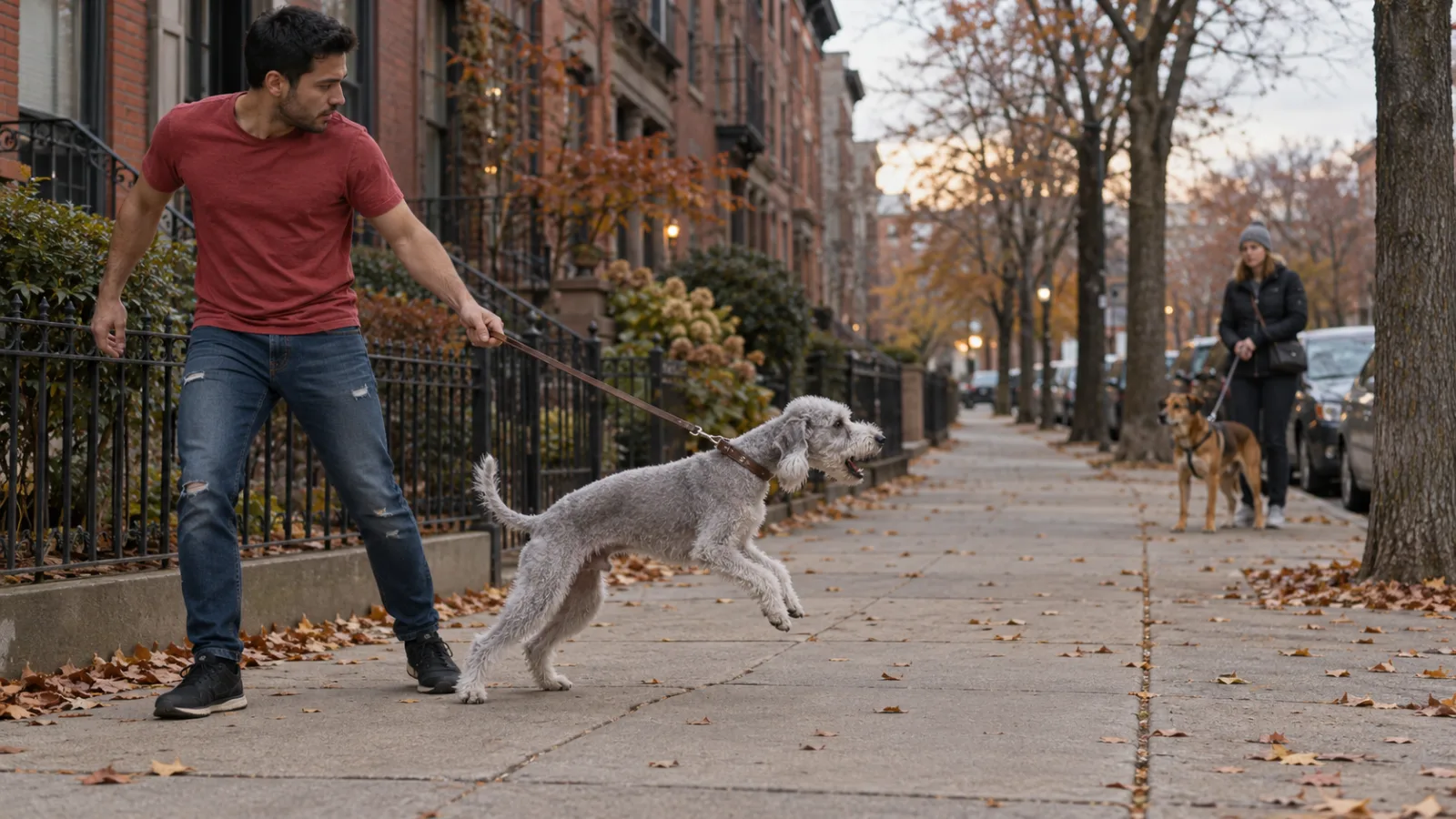
You head out for a walk. A dog rounds the corner, and your dog starts barking and pulling. You grip the leash, apologize, and wish you could head home. It is exhausting, but things can improve.
If you wonder why your dog barks at other dogs on walks, fear, frustration, or overwhelming excitement may be behind it. During an outburst, create distance first. Practice training when your dog can cope.
Is My Dog Aggressive? Understanding Reactivity
Reactivity is a strong response to a trigger, such as an approaching dog. Calling a dog “leash-aggressive” describes what you see, but does not explain why it happens. Barking and lunging do not prove your dog intends to hurt another dog. They do not mean a greeting is safe, either.[1]
Barrier Frustration: Wanting to Say Hello but Being Held Back
Some dogs want to approach and play, but the leash stops them. This barrier frustration can lead to jumping, pulling, and barking. That does not mean you should unclip the leash or allow a greeting. High arousal can make even a friendly interaction difficult.[1]
Fear-Based Reactivity: “Stay Away From Me”
A frightened dog may bark to create distance. The leash limits their ability to move away, which can intensify the response. This is a defensive reaction, not a calculated plan to attack. A stiff body, crouching, or attempts to retreat offer clues. Barking or a wagging tail alone cannot tell you how a dog feels.[2]
The Key Concept: Understanding Your Dog’s Threshold
Threshold is the point where exposure to a trigger becomes difficult to handle. Distance matters, but so do the encounter’s duration, the other dog’s movements, and nearby activity. Training should happen below threshold, without pushing your dog into an outburst.[3]
Green, Yellow, and Red: Recognizing Rising Stress
Think of a traffic light as a guide, not a diagnosis:
- Green: Your dog notices the other dog, stays relatively loose, and can look away.
- Yellow: Your dog stares, stiffens, and struggles to disengage. Add distance now.
- Red: Your dog barks, lunges, and has trouble responding to you. Stop training and move away.
Taking a treat can help you assess the situation, but it does not prove your dog is relaxed. Watch their body and ability to shift attention, too.[2][3]
Why You Should Not Try to Discipline a Dog in the Red Zone
An overwhelmed dog struggles to practice the behavior you want. Repeating “sit” or shouting does not resolve the distress. Focus on leaving safely. Learning still happens during these moments, so a painful or frightening encounter can strengthen negative associations.[3][4]
A Training Plan: Look at That (LAT)
Teaching Your Dog to Notice a Trigger and Check In With You
LAT teaches a simple sequence: notice another dog, then reconnect with you.
- At home, say a marker word like “yes,” then immediately give a treat. Repeat until the word predicts the reward.
- Outside, start far enough away that your dog can see another dog while staying below threshold.
- When your dog calmly looks at that dog, say “yes” and deliver a treat close to you. Initially, do not wait for eye contact.
- Once this is familiar, reward your dog for voluntarily looking back at you after noticing the other dog.
- End after a few successful repetitions. Reduce distance gradually, only when your dog is comfortable.
If your dog fixates, barks, or struggles to turn back toward you, move farther away. Adjusting the exercise is not a failure.[5]
LAT reinforces behavior and can also change emotions. Classical counterconditioning pairs a trigger with something pleasant: another dog’s appearance predicts a favorite food. Your dog does not need to perform a “sit” to receive food during counterconditioning.[3]
Using High-Value Treats, Such as Hot Dogs or Cheese
Choose something your dog loves that suits their health needs. Plain cooked chicken or training treats may work. Use hot dogs or cheese only in tiny amounts, if tolerated, because of their salt and fat content. Avoid products containing onion or garlic. Never lure your dog closer with food. Treats support safe exposure; they do not replace distance.[1][3]
Handling Surprise Encounters on Busy Streets
Make a U-Turn and Use Visual Barriers
What should you do when your dog loses control at the sight of another dog? Say “let’s go,” turn, and walk away smoothly. Practice this cue in a quiet place first, rewarding your dog for following.[2]
A parked car or wall can block the view. Stay on the sidewalk, away from traffic. Ask the other person for space. Never put your hands between dogs or force a greeting. The immediate answer to calming a reactive dog is often less exposure and more room.
Why Choke and Prong Collars Can Make Reactivity Worse
Pain or intimidation can add distress and become associated with other dogs. Even if barking stops, the underlying emotion may remain. The American Veterinary Society of Animal Behavior (AVSAB) recommends reward-based training and advises against methods that cause pain or fear.[4]
For a reactive dog, consider a well-fitted Y-shaped harness that is comfortable and secure against slipping out. Front and back attachment points may improve control. Equipment supports management; it does not treat reactivity by itself.[1]
Frequently Asked Questions
Why Is My Dog Friendly Off-Leash at the Dog Park but Reactive on Leash?
Off-leash dogs have more freedom to approach or retreat. The difference may reflect fear or frustration, but it is not a diagnosis. Do not release your dog on the street to test it.[5]
Will Yelling or Jerking the Leash Stop the Barking?
It may interrupt the behavior briefly while adding pain or fear. Choose distance and reward-based training instead.[4]
How Long Does It Take to Help a Reactive Dog?
There is no fixed timeline. Progress depends on the cause, severity, and environment. Track faster recovery and easier disengagement, not just fewer barks.[5]
Should I Use a Very Short Leash or a Longer One?
Allow some slack while maintaining safe control. Adjust the length on crowded sidewalks. In open areas, a harness and longer leash can allow more freedom without letting your dog reach others.[1]
Does Neutering Reduce Reactivity Toward Other Dogs?
Neutering may affect hormone-related behaviors, but it is not a guaranteed solution for fear or frustration. Some forms of aggression may persist or worsen. Discuss the decision with your veterinarian.[6]
Set Your Dog Up for a Better Walk
Choose quieter routes and times. Vupo’s live dog-walking map can help you plan around dogs nearby. It is a planning aid, not a guarantee that every dog appears on the map or that surprises will never happen.
For sudden behavior changes, see your veterinarian to check for pain or illness. If there is a bite risk or you cannot safely manage your dog, seek a qualified professional who uses reward-based methods. Gradual training to wear a properly fitted basket muzzle may also help.[1][2]
For more on the blog, read How to Teach Your Dog to Walk on a Leash and Dog Parks and Canine Body Language.
Professional Sources
- Dogs Trust — Understanding Reactive Dogs
- Battersea — Living with a Reactive Dog
- VCA Animal Hospitals — Introduction to Desensitization and Counterconditioning
- AVSAB — Position Statement on Humane Dog Training
- Best Friends Animal Society — Dealing with Leash Reactivity
- VCA Animal Hospitals — Dog Neutering and Behavior