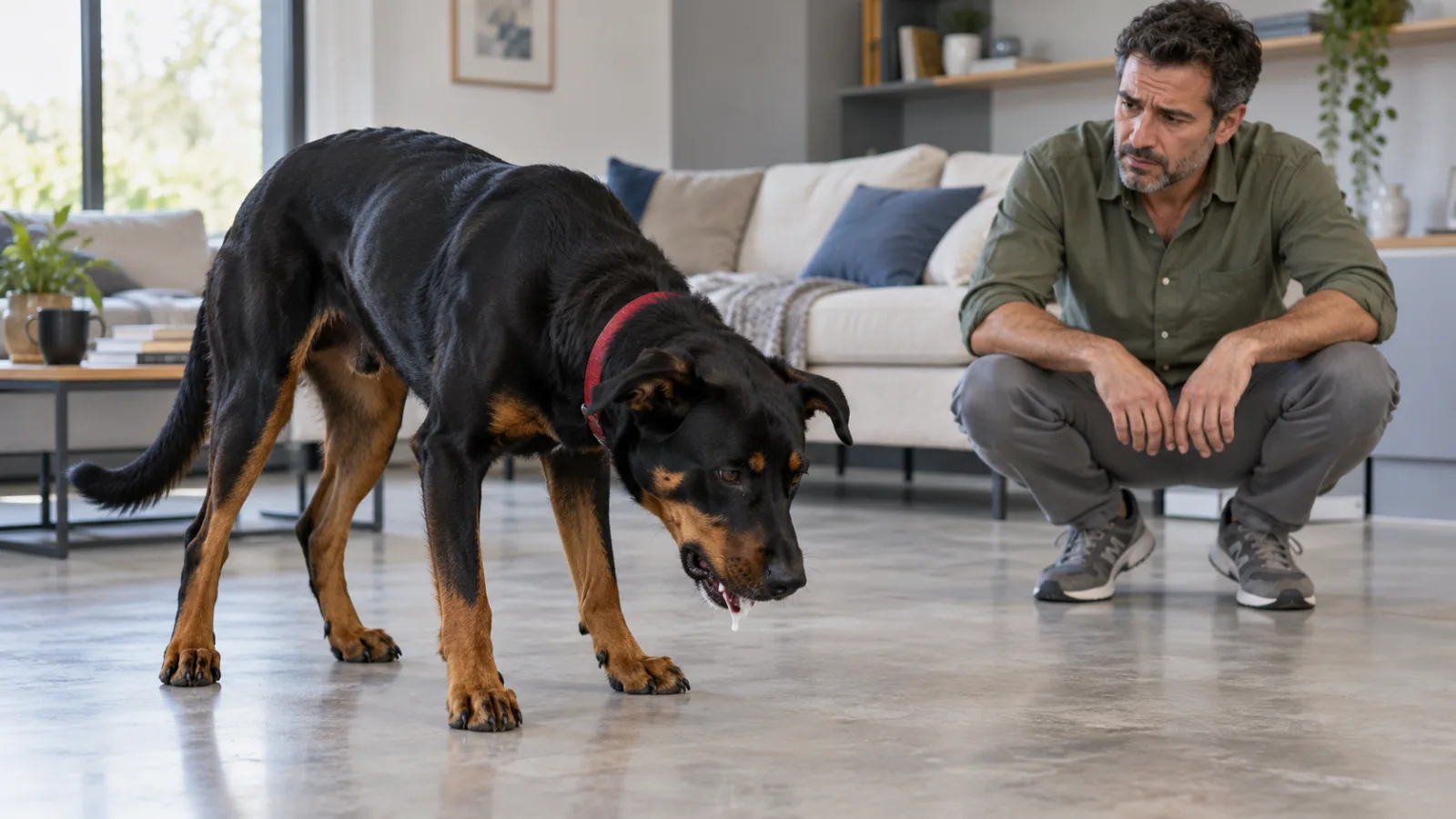
Repeated attempts to vomit without bringing anything up, a swollen belly, collapse, or trouble breathing require immediate emergency veterinary care. Do not wait to see if the problem passes.
This article provides general information. It does not replace a veterinary examination or advice from your veterinarian.
Vomiting may be a brief episode or a sign of serious illness. The color of the vomit is only a clue. Your dog's behavior, how often they vomit, and whether they can keep water down matter more. Even one episode can be concerning if your dog may have swallowed a toxic substance or an object.
Emergency Care or Home Monitoring? A Quick Decision Guide
| What do you notice? | What should you do? |
|---|---|
| Repeated attempts to vomit with nothing coming up, especially with drooling or restlessness | Go to an emergency vet immediately, even without obvious belly swelling |
| Collapse, trouble breathing, severe weakness, or a swollen and painful belly | Go to an emergency vet immediately |
| A large amount of blood, vomit resembling coffee grounds, or vomiting with bloody diarrhea and weakness | Seek emergency care immediately |
| Possible ingestion of a toxic substance, medication, toy, or other object | Call a veterinarian immediately and follow their instructions |
| Repeated vomiting or an inability to keep water down | Seek urgent veterinary care; do not wait until tomorrow |
| One episode in a healthy adult dog who acts normally and has no warning signs | Close monitoring at home may be appropriate; contact your vet if vomiting happens again |
If you are unsure what to do, call your veterinary clinic. [1,2]
Vomit Colors and Textures: What Can They Tell You?
Dog Vomiting White Foam: Possible Causes
White foam may contain saliva, mucus, and stomach fluid. It can appear when the digestive tract is irritated or the stomach is nearly empty. However, it does not rule out a blockage or another serious problem.
Why does a dog vomit white foam after drinking water? Drinking quickly may play a role, but you should not assume that is the cause. Notice whether your dog is vomiting, regurgitating, or coughing up foam. Repeated episodes need a veterinary examination.
If coughing comes before the foam, see Vupo's article on kennel cough. Trouble breathing requires immediate care. [1,3]
Yellow or Greenish Fluid: Is It Bile?
Yellow fluid may contain bile, which helps digest fat. If your dog vomits yellow fluid in the morning, one possible cause is bilious vomiting syndrome. This can happen after a long period without food, when bile flows back from the intestine into the stomach and irritates it.
Color alone cannot confirm this diagnosis. Other illnesses can cause similar vomiting. After evaluating your dog, your vet may suggest smaller, more frequent meals and a small meal before bedtime. Green vomit can also come from eating grass. [1,4]
Undigested Food: Regurgitation or Vomiting?
Vomiting usually involves effort and abdominal contractions. Drooling and nausea may come first. With regurgitation, food comes back up with little or no effort.
Vomit can also contain undigested food, so its appearance alone does not tell the whole story. A short video can help your vet tell the difference. Repeated regurgitation needs investigation because it may indicate a problem with the esophagus, the tube that carries food to the stomach. [3]
Brown or Bloody Vomit: When Should You Suspect Bleeding?
Brown vomit may get its color from food. However, dark, grainy material that looks like coffee grounds may be partially digested blood. Fresh blood may look red.
Contact a veterinarian immediately if you see blood in your dog's vomit. A large amount of blood, a coffee-ground appearance, weakness, or black stools calls for urgent veterinary care. Even a small streak of blood should not be diagnosed at home. [1,5]
Emergency Warning Signs You Should Never Ignore
Dry Heaving: A Possible Sign of Bloat and GDV
If your dog repeatedly tries to vomit but nothing comes up, or only a little foam appears, one concern is gastric dilatation-volvulus (GDV). This is a dangerous condition in which the stomach expands and twists. It is often called bloat. Other signs include restlessness, drooling, and a swelling belly.
GDV is life-threatening and requires immediate treatment, including surgery when the stomach has twisted. Large dogs and dogs with deep chests are at greater risk, but other dogs can develop it too.
Do not wait for every symptom or for obvious swelling. Do not try home remedies or force food or water. Call the emergency clinic while preparing to leave. [2]
Repeated Vomiting With Weakness or Bloody Diarrhea
A dog with both vomiting and diarrhea can lose fluids quickly. Weakness, pain, reduced responsiveness, or an inability to keep water down requires urgent veterinary attention.
Treatment depends on the cause. Your dog may need fluids and medication. Blood tests, X-rays, or an ultrasound may also be necessary. Stopping the vomiting does not always resolve the underlying problem. [1,3]
Vomiting in an Unvaccinated Puppy: Rule Out Parvo
A vomiting puppy who has not completed their vaccination series needs prompt veterinary assessment. This is especially important if the puppy is weak, refuses food, or has diarrhea. Canine parvovirus, often called parvo, is one serious possibility, but it is not the only one.
Do not wait for bloody diarrhea to appear. Keep the puppy away from other dogs. Call the clinic before arriving so the staff can take steps to prevent infection from spreading. [6]
What Can You Do at Home After One Episode?
Water, a Brief Food Break, and a Gradual Return to Eating
Home monitoring is appropriate only for an otherwise healthy adult dog with no warning signs and no suspected poisoning or swallowed object.
- Do not routinely withhold water. Offer small amounts frequently. Do not force your dog to drink or give water by syringe. If your dog cannot keep water down, seek urgent care.
- Ask your vet whether a brief break from food is appropriate. Prolonged fasting is not suitable for every dog, especially puppies, dogs with diabetes, or dogs with other medical conditions.
- Once vomiting has stopped and your dog can keep water down, offer small portions of easily digested food as directed by your vet.
- Plain boiled chicken without skin, bones, or seasoning, served with white rice, may be suitable for a short time. It is not a complete long-term diet and is not right for every dog.
- Photograph the vomit and record when it happened, how often it happened, what your dog ate, and any other symptoms. Never delay emergency care to collect this information. [3,5]
Do not try to make your dog vomit unless a veterinarian specifically tells you to do so. If you suspect exposure to a harmful substance, call immediately and bring its packaging to the clinic.
Reducing Common Triggers: Slower Eating and Regular Meals
Avoid sudden food changes. Keep trash, medications, and small objects out of reach. If your dog gulps food, try a slow-feeder bowl and divide the daily food allowance into smaller meals. Recurring vomiting, even once a week, deserves a veterinary evaluation. [2,5]
For more information, see Vupo's article on foods dogs can and cannot eat. Keep a clear record of vomiting episodes with your dog's health information and share it with your vet. Do not wait for community replies during an emergency.
Frequently Asked Questions
What Is the Difference Between Regurgitation and Vomiting?
Regurgitation usually happens with little or no effort. Vomiting typically involves abdominal contractions and an active effort to bring material up. [3]
Why Does My Dog Vomit Yellow Fluid Early in the Morning?
The overnight gap between meals may contribute to bilious vomiting. If it keeps happening, your vet should rule out other causes before changing the treatment plan. [4]
Does Eating Grass Make Dogs Vomit?
Some dogs vomit after eating grass, but many do not. Eating grass does not prove that a dog feels nauseated, and it is not a treatment for nausea. [7]
When Should I Not Wait Even an Hour?
Do not wait if your dog repeatedly tries to vomit without bringing anything up, collapses, struggles to breathe, has a swollen and painful belly, or has significant bleeding. Suspected poisoning also requires an immediate call. [1,2]
Can I Give My Dog Reglan or Another Human Anti-Nausea Medication?
Only with specific instructions from a veterinarian. Reglan contains metoclopramide, which can be unsafe when there is a blockage or bleeding in the digestive tract. Do not reuse an old prescription without checking with your vet. [8]
Veterinary Sources
- AAHA: Why Is My Dog Throwing Up?
- American College of Veterinary Surgeons: Gastric Dilatation-Volvulus
- MSD Veterinary Manual: Vomiting in Dogs
- University of Illinois: Bilious Vomiting Syndrome
- Cornell University: Vomiting
- Cornell University, Baker Institute: Canine Parvovirus
- VCA Animal Hospitals: Why Dogs Eat Grass
- VCA Animal Hospitals: Metoclopramide