This article provides general guidance and is not a substitute for veterinary advice. If you suspect heatstroke, start cooling your dog immediately and seek emergency veterinary care.
How many times a day should you take your dog out, and how long should each walk last? In summer, the answer also depends on the conditions outside. A route that feels pleasant in winter can become scorching hot by midday, while humidity makes it harder for your dog to cool down.
For a healthy adult dog, 3-4 outings a day are a practical starting point. In summer, schedule longer walks during cooler hours and shorten daytime outings as conditions require. Walk length should suit your dog and the weather conditions — even a short walk can be dangerous in extreme heat.
How Often Should You Walk Your Dog, and for How Long?
Distinguish between a potty break and a walk that provides exercise, sniffing, and mental stimulation. Not every outing needs to be long, but potty breaks alone will not meet all of your dog's needs over time.
- Healthy adult dogs: A starting schedule might include two 20-30-minute walks during cooler hours, plus one or two potty breaks. This is a planning example, not a required exercise quota.
- Puppies: Need more frequent outings, especially after sleeping, eating, and playing. Keep exposure to the outside world brief and age-appropriate, following your veterinarian's guidance on safe socialization.
- Senior dogs or dogs with medical conditions: Often benefit from shorter, more manageable sessions tailored to their individual needs.
- High-energy dogs: May need more activity, but in hot weather, provide additional stimulation through scent games and short training sessions in an air-conditioned home.
Watch your dog, not just the clock. Slowing down, seeking shade, or stopping is a reason to pause and check for overheating, pain, or difficulty keeping up. Do not pull your dog along. Even a dog that keeps chasing a ball can overheat.
Why Are Dogs So Sensitive to Heat?
Limited Sweating and a Reliance on Panting
Dogs do not sweat across their bodies the way people do. They have sweat glands in their paw pads, but these contribute little to cooling. Dogs cool themselves primarily by panting, which allows moisture to evaporate from their respiratory tract. High humidity makes this process less effective, so even an evening without direct sun can be dangerous.
Dogs at Higher Risk
Flat-faced, or brachycephalic, dogs such as Bulldogs and Pugs may struggle to release heat because of their airway anatomy. Puppies, seniors, overweight dogs, and dogs with thick coats or underlying health conditions also need extra precautions. Black fur may absorb more solar radiation, but coat color alone does not determine risk. Veterinary guidance on heatstroke risk factors - PDSA.
Hot Pavement and the Seven-Second Test
The Ground Can Be Much Hotter Than the Air
When the air temperature is around 86°F (30°C), sun-exposed asphalt can reach approximately 131°F (55°C) or higher. This is not a fixed relationship: surface material, sunlight, and exposure time all affect the temperature. Sand and artificial turf can also cause burns. Veterinary advice on hot surfaces - AKC.
The Seven-Second Test: A Warning Check, Not a Safety Guarantee
Carefully place the back of your hand on the surface. If you cannot comfortably keep it there for seven seconds, do not walk your dog on it. Remove your hand immediately if it hurts; there is no need to finish the test.
Passing this check does not prove that the route is safe. It is a rough screening tool and does not assess heatstroke risk. Choose a shaded route with cool surfaces, and check again whenever the ground surface changes.
Heatstroke in Dogs: Recognizing the Signs
Early Warning Signs
Unusually heavy panting, thick drool, labored breathing, weakness, and very red gums may indicate dangerous overheating. Vomiting and diarrhea can also occur.
Signs of a Critical Emergency
Loss of coordination, confusion, collapse, seizures, or unconsciousness require emergency care. Do not wait for every symptom to appear or delay action to take your dog's temperature. Recognizing heatstroke in dogs - RSPCA.
First Aid for Suspected Heatstroke During a Walk
- Stop activity and move your dog into shade or an air-conditioned area. Do not force your dog to walk to the car.
- Immediately wet your dog's body with cool or cold tap water. Make sure the water reaches the skin, and keep it away from the mouth and nose.
- Add airflow. A fan or air conditioning helps with cooling. Do not wrap your dog in a wet towel, which can interfere with heat loss.
- Call a veterinarian and seek emergency care. Begin cooling before transport and continue as safely as possible in an air-conditioned vehicle. Do not wait for a full recovery before leaving.
- Offer drinking water only if your dog is conscious and able to swallow. Never force water into the mouth.
Start cooling your dog immediately with cold tap water — there is no need to wait for lukewarm water. Current guidance supports rapid cooling with available water. A dog with suspected heatstroke still needs veterinary evaluation, even if they seem to recover. Heatstroke first-aid guidance - PDSA.
Simple Rules for Walking Your Dog in Summer
- Schedule longer walks early in the morning or in the evening after conditions have cooled. Temperature and humidity matter more than the time on the clock.
- Keep afternoon walks shorter. If it is still hot, take a potty break and postpone exercise.
- Choose shaded routes and cool ground for midday outings to reduce the risk of paw burns. Pavement does not cool immediately when shade reaches it.
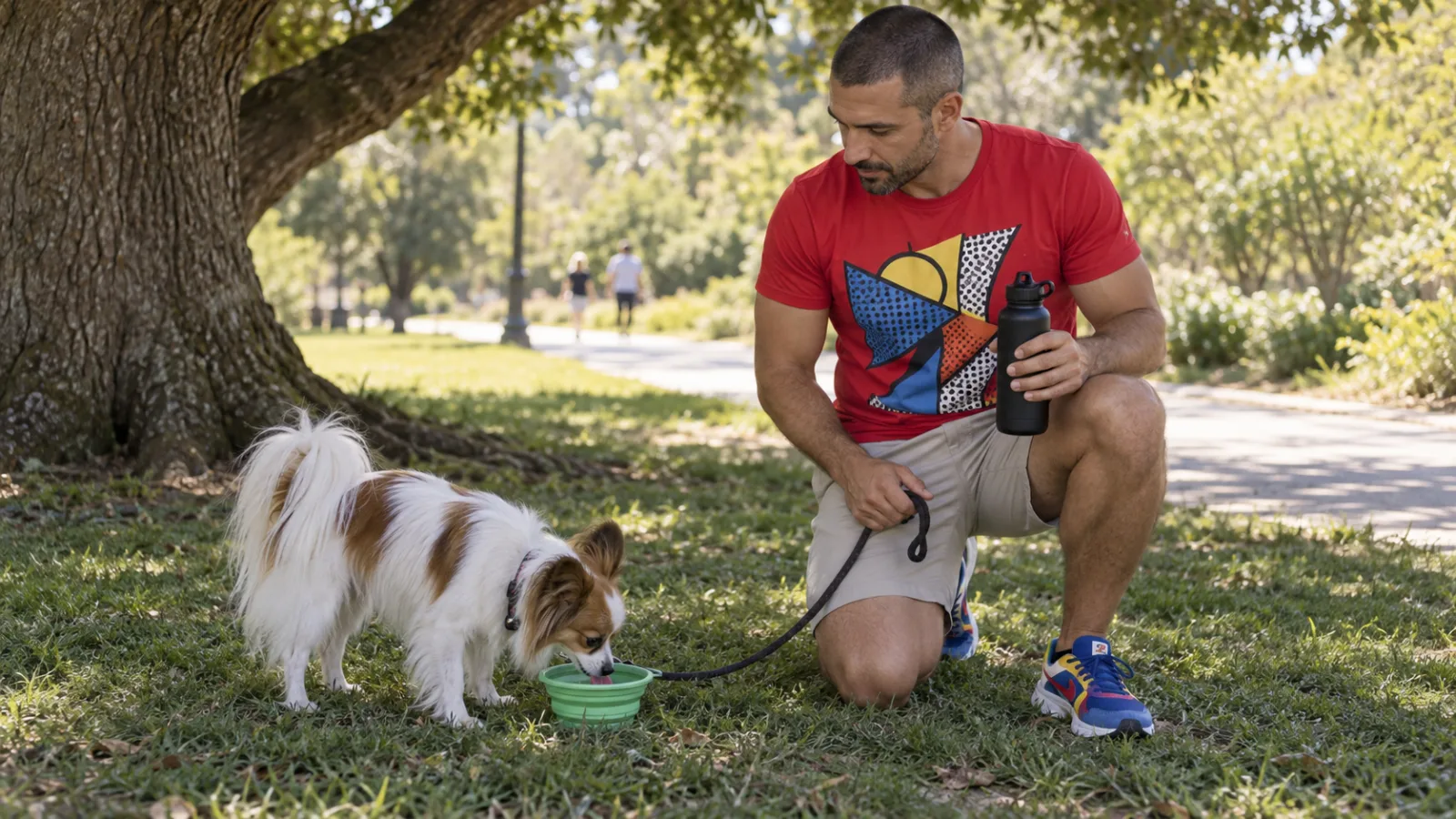
- Bring water and a bowl, and offer water breaks.
- Skip running, biking with your dog, and intense games of fetch in the heat, including at the dog park.
- During extreme heat, shorten outings further and add indoor enrichment. Do not push to meet a time or distance target outdoors.
With Vupo, you can track when you walk and how long each outing lasts. Use that record to plan your routine, alongside checking the weather and observing your dog.
Frequently Asked Questions
What Are the Best Times to Walk a Dog in July and August?
Early morning and late evening are usually better options. Before 8:00 a.m. and after 8:30 p.m. can serve as rough planning examples, but they are not automatically safe. Local climate, daylight hours, heat waves, and humidity all matter. A shaded potty break may last only a few minutes, but even five minutes is not a safety guarantee.
Should I Avoid Cold Water Because It Constricts Blood Vessels?
A blanket ban on cold water is not appropriate. Current guidance emphasizes prompt cooling, and cold tap water is suitable. You do not need to prepare an ice bath or delay cooling while searching for water at a specific temperature. Cooling guidance - RSPCA.
Does Shaving My Dog Help in Summer?
Not necessarily. Double-coated dogs generally should not be shaved unless a professional identifies a specific need. Their coats also protect against sun exposure, and shaving can affect regrowth. Regular brushing and grooming suited to the coat type are better options. Summer grooming guidance - AKC.
Can My Dog Drink Cold Water With Ice?
Healthy dogs can have cold drinking water with a little ice added to the bowl. Avoid letting your dog chew large, hard ice cubes, which can damage teeth. Drinking water does not replace external cooling and veterinary treatment in an emergency.
How Can I Recognize Burned Paw Pads?
Limping, persistent licking, tenderness, blisters, or peeling skin may indicate burns. Stop walking on the surface, gently cool the paws with cool water, and contact your veterinarian. Do not apply products intended for people without veterinary guidance.
What Are the Signs of Dehydration in Dogs?
Dry or sticky gums, weakness, sunken eyes, and reduced urination may indicate dehydration. A dry nose alone is not diagnostic. If these signs occur with unusually heavy panting or altered alertness, treat the situation as an emergency.