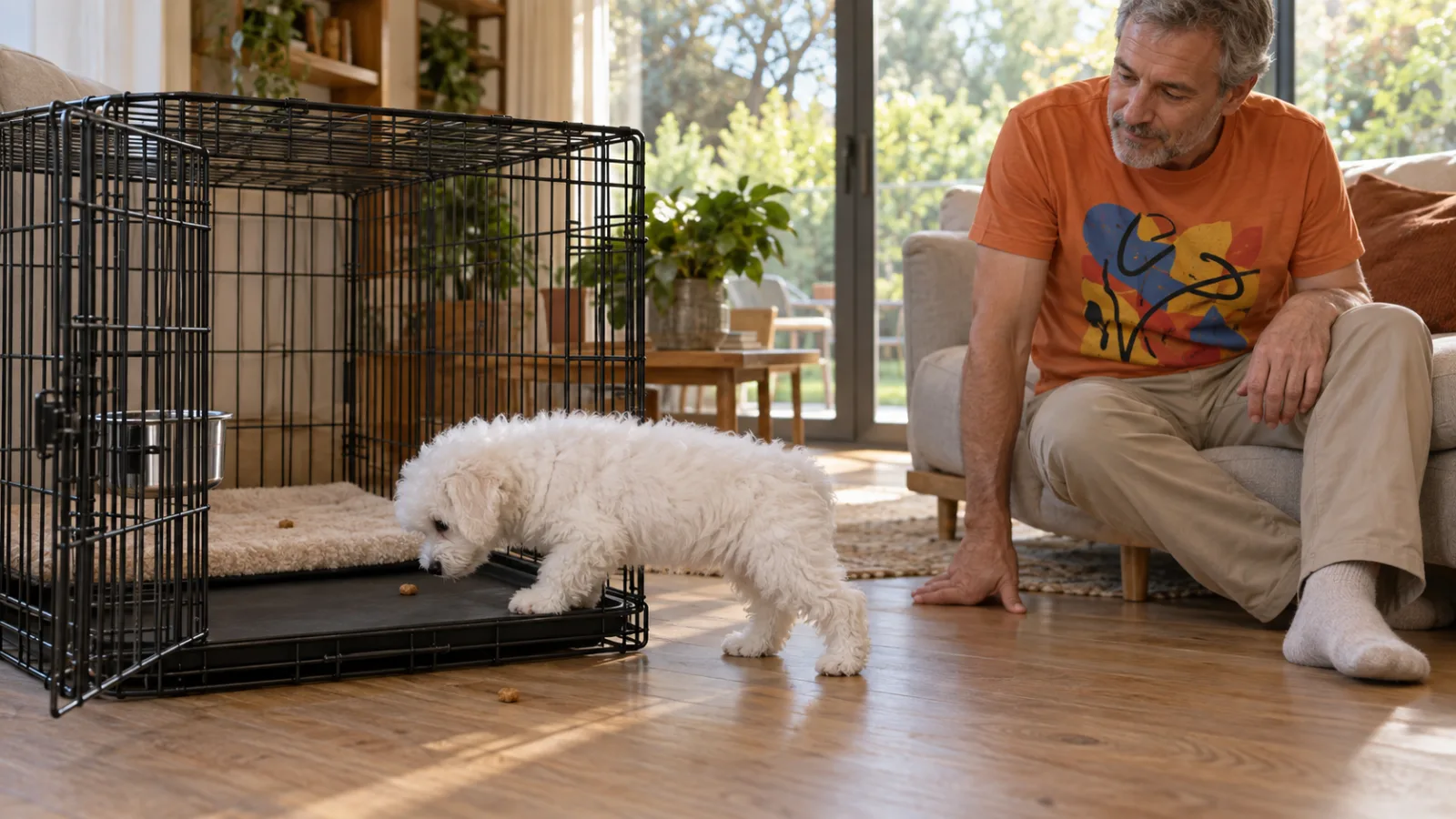
Does your puppy follow a treat into the crate, then start crying when you close the door? That means you need to adjust the training. Crate training starts with building confidence: let your puppy enter willingly, create pleasant experiences, and progress slowly.
No method can promise zero crying. You can, however, avoid leaving your puppy in distress and gradually teach them that the space is a comfortable place to rest. The same principles apply to puppy playpens and adult dogs.
Why Use a Dog Crate or Puppy Playpen?
A Safe Retreat, Not a Jail
A crate can become a cozy retreat, but it does not naturally calm every dog. Your dog learns to feel safe through positive experiences. An open door, comfortable bedding, and undisturbed rest help build that feeling. A crate is not essential in every home. RSPCA - Using a Crate Safely.
Protecting Your Puppy and Your Home
A crate or playpen can temporarily limit access to cords, shoes, and dangerous objects when you cannot supervise closely. It does not replace play, walks, family time, or teaching your puppy to chew appropriate toys. A dog who tries to force their way out can get hurt inside a crate, too. VCA - Crate Training and Confinement.
Supporting Potty Training
Many puppies prefer not to soil their sleeping area. A crate can help you manage potty training, but it does not teach your puppy where to go on its own. Provide timely potty breaks and reward your puppy after they go in the right place. Never make a puppy hold it longer than they can comfortably manage. Humane World for Animals - Crate Training.
Related reading: A Practical Guide to Puppy Potty Training.
Choosing the Right Setup: A Wire Crate or Folding Playpen
Consider these pros and cons before buying:
- Wire crate: Creates a defined resting space but allows less movement than a playpen.
- Puppy playpen: Offers room for a bed, water, and play, but takes up more floor space. Some puppies may climb over it or push it around.
- Combined setup: An open crate inside a playpen lets your puppy choose between resting inside and moving around the pen. Dogs Trust - Crates and Playpens.
Choosing a Size as Your Puppy Grows
Your dog should be able to stand without crouching, turn around, and lie down fully stretched out. Check the fit regularly as your puppy grows. If you use a divider, make sure it still allows all these movements. The pen must be stable, with no gaps that could trap your puppy's head or legs.
Where Should You Put It?
Choose a quiet spot near the family, away from direct sunlight and busy walkways. Add suitable bedding and water in a stable bowl. During the first few nights, keeping your puppy near where you sleep can help you notice when they need a potty break. RSPCA, VCA.
Four Steps to Positive Crate Training
Practice after a potty break and appropriate activity, when your dog is ready to settle. Several short sessions are better than one long session. Let your dog's response guide your progress, rather than following a fixed schedule.
Step 1: Keep the Door Open and Offer Food Inside
Secure the door open. Place a little food at the entrance, then gradually farther inside. Let your puppy enter and leave freely. You can offer meals inside, but start near the doorway if your puppy seems hesitant. Never push them in or suddenly close the door as soon as they enter. Humane World for Animals.
Step 2: Briefly Close the Door With a Food Toy Inside
Thirty seconds may be a goal later. At first, close the door for just a second or two, then reopen it. Stay beside the crate or pen. If your dog remains relaxed, gradually add a little more time.
You can offer a food-stuffed toy containing part of their meal, or a suitable lick mat, under supervision. The goal is a pleasant experience, not a distraction that lets you keep the door closed longer than your dog can handle. PDSA - Crate Training Steps.
Step 3: Gradually Move Away
Once your dog is comfortable with the door closed, take one step away and return. Later, move around the room before briefly stepping out. For example, practice taking one step, returning, and sitting down before trying two steps.
Do not increase both distance and time away in the same attempt. A camera can help you check how your dog responds when you leave the room. Dogs Trust, VCA.
Step 4: Encourage Your Dog to Choose the Space for Rest
Leave the space open whenever possible. When your dog enters and lies down on their own, offer quiet praise or place a treat nearby. You do not need to close the door every time they enter. This helps the crate become a safe resting place, not just somewhere to get food. Dogs Trust.
Essential Crate Training Rules
Never Use the Crate as Punishment
Do not shove your puppy inside after a bite, bang on the bars, or leave them to cry until exhausted. Separation anxiety needs appropriate treatment. A crate alone is not a solution. PDSA.
Before closing the door, remove collars, harnesses, and leashes that could get caught. Keep water available and choose toys you have already checked during supervised use. If your dog tears off and swallows pieces, do not leave that item with them unsupervised.
How Long Can a Dog Stay in a Crate?
No age-based formula guarantees that a puppy will be safe and comfortable in a crate. Being able to hold their bladder does not mean they can stay calm alone.
| Age or training stage | Practical guidance |
|---|---|
| Just starting, at any age | Begin with seconds and increase only while your dog remains comfortable |
| Puppies 2-3 months old | Plan frequent potty breaks; do not assume they can stay crated for hours |
| Puppies under 6 months | Humane World gives a general upper limit of 3-4 hours; many puppies need shorter periods |
| Adult dogs comfortable in a crate | PDSA recommends no more than 3 hours at a time; some dogs need less |
These are general limits, not training goals. If your dog needs a break sooner, provide one. Sleeping at night does not guarantee that a puppy can go without a potty break. A full workday requires another arrangement, such as someone coming to care for your puppy. Humane World for Animals, PDSA.
Frequently Asked Questions
What if My Puppy Starts Crying Intensely as Soon as I Close the Door?
Consider fear, a need to go potty, or discomfort with being confined. If your puppy cries intensely, drools, or tries to escape, open the door safely and stop the session. Do not wait for silence when your puppy is distressed. Return to an easier step. For significant distress, consult your veterinarian and a positive reinforcement trainer. VCA.
Related reading: Why Your Puppy Cries at Night.
How Long Can a 3-Month-Old Puppy Stay in a Crate?
Being 3 months old does not automatically mean a puppy can stay crated for three hours. While your puppy is awake, planning potty breaks every one to two hours is a cautious starting point. Some puppies need to go sooner. This is a schedule for offering potty breaks, not a recommendation to keep your puppy crated between them.
Should I Put a Pee Pad Inside the Crate?
Usually, not in the sleeping area. If your puppy needs an indoor potty option, use a larger enclosure with a separate potty area away from the bed and bowls. Do not expect a young puppy to hold it simply because there is no pad. VCA.
Can Adult Dogs Be Crate Trained?
Yes. Adult dogs can learn to use a crate, too. Adjust the pace to their past experiences and current response. If your dog struggles with a crate, a dog-proofed room or playpen may be a better option. VCA.
When Can I Stop Using the Crate and Give My Dog Access to the Whole House?
Start when your dog is reliably potty trained, avoids chewing dangerous objects, and stays relaxed while you are away. Begin with one safe area and short absences, then gradually expand access. You can keep the crate open as a resting spot. Humane World for Animals.
Make Training Part of Your Daily Routine
Build a simple routine: potty break, activity, a short training session, and rest. For more guidance, read A Daily Routine for Your New Puppy. You can work on crate training alongside Vupo's training program and a consistent schedule for walks and rest. Success means your dog willingly enters and rests comfortably, not simply that the door stays closed for a certain number of minutes.